The premium Android smartphone landscape has reached an unprecedented peak of engineering sophistication. At the absolute pinnacle of this ecosystem stand two undisputed heavyweights: the Google Pixel 9 Pro and the Samsung Galaxy S24 Ultra. Each represents its creator's uncompromising vision of what mobile computing should deliver in 2026. Google positions the Pixel 9 Pro as the ultimate expression of clean Android software, cutting-edge computational photography, and ambient on-device artificial intelligence. Conversely, Samsung champions the Galaxy S24 Ultra as the consummate hardware powerhouse—an unapologetic productivity juggernaut boasting titanium construction, integrated S Pen stylus capability, a colossal display, and top-tier silicon performance.
For consumers seeking the definitive Android flagship experience, deciding between these two elite devices involves far more than comparing raw spec sheets. It requires understanding fundamentally divergent philosophies regarding software design, camera color science, display ergonomics, daily battery endurance, and multi-year software longevity. In this in-depth editorial comparison of the Pixel 9 Pro vs Galaxy S24 Ultra, we analyze both devices across every critical dimension based on verified manufacturer hardware specifications, industry benchmark data, display lab measurements, and extensive community user feedback.
Editorial Note: Retail pricing, carrier promotional incentives, and regional trade-in values fluctuate frequently—prices may change, so always check the official Google Store and Samsung channels for current deals.
Design, Ergonomics, and Build Quality

How a flagship feels in the hand over hours of daily interaction dictates long-term satisfaction. In this generation, both manufacturers have refined their exterior industrial design with premium metals and refined finishes, yet their physical footprints cater to distinctly different preferences.
Galaxy S24 Ultra: Titanium Rigidity and Maximalist Scale
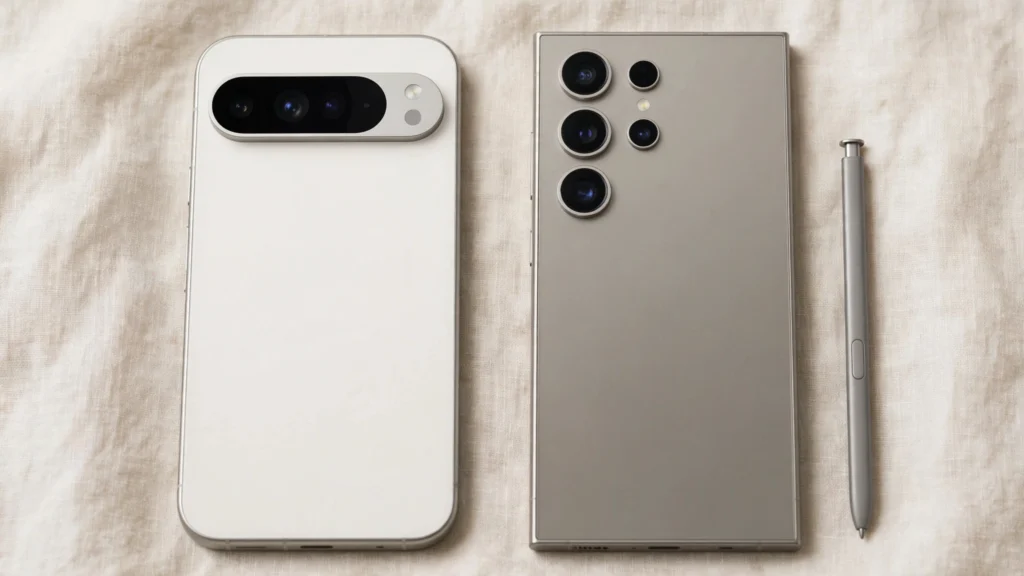
The Samsung Galaxy S24 Ultra makes no apologies for its immense physical presence. Built around an aerospace-grade titanium frame with sharp, defined corners and completely flat front and rear glass, the S24 Ultra exudes industrial authority. Measuring 162.3 x 79.0 x 8.6 mm and weighing approximately 232 grams, it is undeniably a two-handed device designed for users who prioritize maximum screen estate above pocket portability.
The flat display glass represents a celebrated ergonomic evolution away from curved display edges of previous generations, virtually eliminating accidental palm touches and simplifying the application of tempered glass screen protectors. The matte satin rear finish resists unsightly fingerprint smudges, while the seamlessly integrated S Pen slot housed along the bottom left corner provides unmatched utility without requiring external cases.
Pixel 9 Pro: Sculpted Aluminum and Ergonomic Versatility
With the Pixel 9 Pro family, Google made a brilliant strategic decision: offering the flagship Pro experience in two distinct physical sizes—the standard 6.3-inch Pixel 9 Pro and the larger 6.8-inch Pixel 9 Pro XL. For this comparison, whether looking at the standard compact Pro or the XL variant, Google utilizes a polished aerospace-grade aluminum frame mated to a silky matte glass back.
The iconic horizontal camera bar—the "visor"—has evolved into a distinctive floating pill-shaped camera island that spans the upper rear chassis. Beyond visual branding, this horizontal bar provides a practical ergonomic benefit: unlike corner-mounted camera arrays that cause smartphones to wobble awkwardly when placed flat on a tabletop, the Pixel rests with absolute stability. The rounded corners and gently contoured perimeter rails make the Pixel significantly more comfortable to hold for extended reading sessions compared to Samsung's angular geometry.
Display Technology and Visual Experience

Both manufacturers produce world-class mobile displays, yet subtle technological divergences in reflection mitigation, resolution, and brightness tuning create distinct real-world viewing experiences.
Samsung's Anti-Reflective Armor and Dynamic AMOLED 2X
The Galaxy S24 Ultra features a stunning 6.8-inch Dynamic AMOLED 2X panel boasting Quad HD+ resolution (3120 x 1440 pixels) at an ultra-sharp 505 pixels per inch (ppi). Driven by an LTPO backplane, the display dynamically scales its refresh rate from a battery-sipping 1Hz up to a silky-smooth 120Hz depending on displayed content.
However, Samsung's most transformative display innovation is not its 2,600-nit peak brightness rating, but its exclusive Corning Gorilla Armor front glass. Gorilla Armor incorporates an advanced anti-reflective surface treatment that reduces ambient light glare by up to 75% compared to conventional smartphone glass. Under direct outdoor sunlight, overhead office fluorescents, or harsh studio lighting, the S24 Ultra retains deep black levels and contrast without turning into a mirror—a tangible daily advantage that laboratory tests and user reviews universally celebrate in this Galaxy S24 Ultra comparison.
Google's Super Actua Display and Outdoor Brilliance
Google counters with its state-of-the-art Super Actua LTPO OLED panel. On the Pixel 9 Pro, this 6.3-inch panel delivers 2856 x 1280 resolution at 495 ppi, while the 6.8-inch 9 Pro XL delivers 2992 x 1344 resolution at 486 ppi. Both models support dynamic 1–120Hz refresh rates.
Where Google takes the lead on paper is raw luminance capability. The Super Actua display achieves an extraordinary 2,000 nits of High Brightness Mode (HBM) and up to 3,000 nits peak brightness when rendering HDR highlights. Google's color calibration adheres strictly to DCI-P3 standards with industry-leading color accuracy, making it a favorite for mobile photographers who require faithful preview rendering rather than saturated color reproduction.
Performance, Silicon, and Thermal Sustained Workloads
Under the hood, this Google vs Samsung flagship clash highlights two contrasting approaches to mobile silicon architecture.
Qualcomm Snapdragon 8 Gen 3 for Galaxy: Raw Compute Supremacy
The Galaxy S24 Ultra is powered globally by the Qualcomm Snapdragon 8 Gen 3 for Galaxy, an overclocked variant of Qualcomm's premier 4nm mobile platform. Featuring an eight-core CPU configuration anchored by an ultra-fast Cortex-X4 prime core clocked at 3.39GHz and an Adreno 750 GPU, the S24 Ultra dominates raw synthetic benchmarks.
Whether handling intensive 3D gaming titles at maximum graphical presets, compiling local code, or rendering 4K 60fps video timelines in mobile editing suites, the Snapdragon platform maintains sustained frame rates without breaking a sweat. Furthermore, Samsung enlarged the internal vapor chamber cooling system by nearly double compared to the S23 series, ensuring effective heat dissipation during marathon gaming sessions.
Google Tensor G4: Optimized for Ambient Intelligence and Efficiency
The Pixel 9 Pro houses Google's custom Tensor G4 processor, paired with a generous 16GB of high-speed LPDDR5X RAM as standard across all configurations. Google engineered the Tensor G4 in close collaboration with Google DeepMind, prioritizing on-device AI model execution (Gemini Nano) and energy efficiency over chasing theoretical benchmark records.
In routine daily tasks—app launching, multitasking, social media navigation, and camera processing—the Pixel 9 Pro feels effortlessly fast and responsive. However, in heavy sustained gaming or extended GPU stress tests, the Tensor G4 throttles thermal output earlier than the Snapdragon 8 Gen 3. If high-performance 3D gaming is your top priority, the Galaxy holds a decisive computational advantage; if responsive daily fluidity and intelligent background services are your focus, Tensor G4 delivers a thoroughly polished experience.
Camera Systems: The Battle for the Best Android Camera Phone

For mobile photography enthusiasts, the camera comparison between these titans represents the core battleground. Both devices consistently vie for the title of best Android camera phone, yet their underlying sensor hardware and computational image pipelines yield strikingly different photographic aesthetics.
Camera Hardware Breakdown
Camera Module | Google Pixel 9 Pro | Samsung Galaxy S24 Ultra |
Primary Wide | 50 MP, f/1.68, 1/1.31" sensor, OIS | 200 MP, f/1.7, 1/1.3" sensor, OIS |
Ultra-Wide | 48 MP, f/1.7, 123° FOV, Macro Focus | 12 MP, f/2.2, 120° FOV, Dual Pixel AF |
Telephoto 1 | 48 MP, f/2.8, 5x optical zoom, OIS | 10 MP, f/2.4, 3x optical zoom, OIS |
Telephoto 2 | None (Uses sensor crop + Super Res Zoom) | 50 MP, f/3.4, 5x optical zoom, OIS |
Front Selfie | 42 MP, f/2.2, 103° FOV, Autofocus | 12 MP, f/2.2, 80° FOV, Dual Pixel AF |
Main Sensor Real-World Shooting Dynamics
Samsung's 200MP ISOCELL HP2 sensor employs 16-in-1 pixel binning to output 12.5MP images by default, with options to capture full 50MP or 200MP high-resolution stills in bright lighting. Samsung's ProVisual Engine renders images with vibrant, punchy colors, excellent dynamic range, and striking sharpness. Green foliage and blue skies pop with saturation, creating visually dazzling photos that require zero post-processing before sharing to social feeds.
Google's 50MP sensor relies on the company's renowned HDR+ processing pipeline. The Pixel prioritizes photographic realism, natural shadow contrast, and accurate skin tones via Real Tone technology. While Samsung sometimes over-brightens shadow areas to produce a flatter, hyper-real image, Google preserves natural contrast and dramatic chiaroscuro. When photographing fast-moving subjects—such as energetic pets or young children playing indoors—Google's Zero Shutter Lag algorithm captures sharp, blur-free shots with far greater consistency than Samsung's slightly slower shutter release.
Zoom Versatility and Telephoto Reach
Telephoto zoom has long been Samsung's trademark calling card. The S24 Ultra features a dual-telephoto configuration: a dedicated 3x 10MP lens for portrait framing and a 5x 50MP periscope lens capable of up to 100x Space Zoom. Between 3x and 10x, the Galaxy produces remarkably crisp optical results, and at 30x it maintains surprising legibility for distant architecture and wildlife.
The Pixel 9 Pro utilizes a single 48MP 5x optical periscope lens backed by Google's Super Res Zoom algorithms. Up to 10x magnification, the Pixel rivals the Galaxy through machine-learning reconstruction. Beyond 15x, Samsung's dedicated secondary telephoto sensor pulls ahead in resolving fine structural textures. However, Google introduces Zoom Enhance in post-processing, an AI generative detail restorer that sharpens distant shots after capture.
Video Recording and Audio Capabilities
Samsung has historically dominated Android video capture, and the S24 Ultra continues this tradition with 8K 30fps recording and 4K 120fps slow-motion capture, complete with smooth lens switching during active recording. Its stabilization is rock-solid, and microphone directionality accurately isolates user audio.
Google has bridged the video gap substantially with Video Boost. When enabled, your 4K video clips upload to Google's cloud processing servers, where multi-frame computational RAW processing applies Night Sight video, dynamic tone mapping, and stabilization before syncing back to your device. The resulting low-light video clips exhibit astonishing clarity and noise reduction that native on-device hardware cannot match in real time.
Software Experience, AI Capabilities, and Update Guarantees
Software represents the clearest philosophical divide between Google and Samsung. Both manufacturers now provide an industry-leading commitment: 7 full years of Android OS upgrades and security patches, ensuring both flagships remain supported well into 2031.
Google's Pixel Experience: Clean, Cohesive, and Gemini-Powered
The Pixel 9 Pro runs clean, unencumbered Android 15 with Google's Material You design framework. There are zero redundant duplicate applications—no secondary app store, duplicate browser, or unremovable promotional utilities. Everything feels unified, intuitive, and intentionally designed.
AI on the Pixel is deeply interwoven into daily interactions rather than marketed as standalone gimmicks:
- Call Screen: Still the undisputed champion of spam defense, Google Assistant answers unknown callers automatically, presents a real-time transcript, and weeds out robocalls before your phone rings.
- Pixel Screenshots: A dedicated on-device visual search engine that indexes every screenshot you take, allowing you to search text, products, or receipts using conversational natural language queries.
- Gemini Live: Direct conversational voice interaction powered by Gemini Nano and Gemini Advanced, capable of brainstorming, summarization, and contextual screen understanding.
Samsung's One UI 6.1+: Power User Customization and Desktop DeX
Samsung's One UI skin is packed with features for power users. Every aspect of the user interface—from notification layouts and gesture navigation to home screen grids and lock screen widgets—can be extensively customized through Samsung's official Good Lock modular suite.
Samsung's ecosystem perks are unmatched for productivity:
- Samsung DeX: Connect the S24 Ultra to an external monitor via USB-C or wireless Miracast, and the phone transforms into a complete desktop computing environment with multi-window multitasking.
- Integrated S Pen: Precision stylus input allows handwritten note-taking on the lock screen, photo retouching, document signing, and remote camera triggering via Bluetooth gestures.
- Galaxy AI: Features like Circle to Search (shared with Google), Live Translate during phone calls, Note Assist auto-formatting, and Interpreter mode provide versatile linguistic assistance.
Battery Life, Charging Speeds, and Thermal Efficiency
All the cutting-edge features in the world matter little if your phone cannot endure a demanding day of travel or intensive work.
Endurance Benchmarks and Capacity
The Galaxy S24 Ultra packs a massive 5,000mAh battery. Combined with the power-efficient Snapdragon 8 Gen 3 chipset and the anti-reflective display (which requires lower brightness indoors), the S24 Ultra is a verified battery endurance champion. Even demanding power users routinely report 7 to 8.5 hours of screen-on time, easily providing 1.5 to 2 full days of moderate use.
The standard Pixel 9 Pro features a 4,700mAh cell, while the 9 Pro XL matches the Galaxy with a 5,060mAh battery. Battery life on the 9 Pro series is significantly improved over the Pixel 8 generation, comfortably delivering a solid full day of active usage (6.5 to 7.5 hours screen time). However, during prolonged outdoor 5G data sessions or extended video recording, the Galaxy retains a modest 10% to 15% endurance advantage.
Wired and Wireless Charging Standards
- Galaxy S24 Ultra: Supports 45W wired charging via USB-C Power Delivery (PD 3.0 with PPS). A compliant 45W brick charges the device from 0% to approximately 65% in 30 minutes, with a full recharge taking around 65 minutes. Wireless charging is rated at 15W.
- Pixel 9 Pro / XL: The standard 9 Pro tops out at 27W wired charging, while the larger 9 Pro XL supports 37W wired charging. Both achieve roughly 70% in 30 minutes when paired with Google's 45W USB-C charger. Wireless charging reaches up to 21W (9 Pro) or 23W (9 Pro XL) when using the official Pixel Stand (2nd Gen).
Head-to-Head Specification Comparison
Feature | Google Pixel 9 Pro / XL | Samsung Galaxy S24 Ultra |
Display Size & Type | 6.3" or 6.8" Super Actua LTPO OLED (1–120Hz) | 6.8" Dynamic AMOLED 2X (1–120Hz) |
Glass Protection | Corning Gorilla Glass Victus 2 | Corning Gorilla Armor (Anti-Reflective) |
Processor | Google Tensor G4 (Titan M2 security) | Qualcomm Snapdragon 8 Gen 3 for Galaxy |
Standard RAM | 16 GB LPDDR5X | 12 GB LPDDR5X |
Storage Options | 128GB / 256GB / 512GB / 1TB | 256GB / 512GB / 1TB |
Stylus Support | No | Yes (Integrated S Pen included) |
Battery Capacity | 4,700 mAh (Pro) / 5,060 mAh (XL) | 5,000 mAh |
Max Wired Charging | 27W (Pro) / 37W (XL) | 45W (USB PD 3.0 PPS) |
Software Support | 7 Years OS Upgrades & Security Drops | 7 Years OS Upgrades & Security Drops |
Frequently Asked Questions (FAQ)
Which phone takes better photos of moving pets and children?
The Google Pixel 9 Pro is universally favored for fast-moving subjects. Google's camera pipeline utilizes instantaneous Zero Shutter Lag and computational motion deblurring, capturing crisp portraits of active children and pets where Samsung's default camera shutter often introduces slight motion blur.
Is Samsung's anti-reflective display glass really that noticeable?
Yes, Corning Gorilla Armor on the Galaxy S24 Ultra is one of the most immediately striking hardware advantages of this generation. By eliminating nearly three-quarters of surface reflections, text and media appear vividly printed on top of the glass, drastically reducing eye strain under bright indoor lighting and harsh outdoor sun.
Can the Pixel 9 Pro match Samsung Galaxy S24 Ultra in 3D gaming?
In casual games, both phones perform identically. However, in demanding graphical titles like Genshin Impact or high-framerate competitive shooters, the Snapdragon 8 Gen 3 inside the S24 Ultra delivers higher average frame rates and sustains maximum performance longer before thermal throttling occurs.
Do both phones offer the same 7-year software guarantee?
Yes. Both Google and Samsung have committed to providing 7 full years of major Android operating system upgrades, Feature Drops/One UI updates, and monthly security patches for these devices. You can purchase either flagship with the confidence that it will remain secure and feature-supported through 2031.
Does the Pixel 9 Pro have an S Pen equivalent?
No. Google does not support active digitizer pens on the Pixel 9 Pro series. If integrated handwriting, precision document signing, fine drawing, or Bluetooth remote camera triggering is a daily requirement for your workflow, the Galaxy S24 Ultra with its built-in S Pen has no competition in this category.
Which device provides better spam protection and call management?
Google's Call Screen on the Pixel 9 Pro remains unmatched across the entire smartphone industry. Google Assistant can converse with unknown callers in real time to filter spam, solicit callers' names and reasons for calling, and transcribe their speech directly to your screen without your phone ever ringing.
Verdict: Which Android Flagship Should You Buy?
Both the Pixel 9 Pro and the Galaxy S24 Ultra deliver phenomenal flagship craftsmanship, class-leading displays, and reassuring 7-year longevity. Your ideal choice hinges entirely on your personal usage priorities:
Buy the Google Pixel 9 Pro if:
- You want the most natural, point-and-shoot camera for capturing candid moments, pets, and authentic portraits.
- You appreciate clean, refined software without bloatware or duplicate app ecosystems.
- You want industry-leading spam call screening and seamless ambient AI integration.
- You prefer the option of a true compact flagship without sacrificing camera lenses or RAM.
Buy the Samsung Galaxy S24 Ultra if:
- You demand the ultimate productivity device with integrated S Pen stylus capability and Samsung DeX desktop mode.
- You spend significant time outdoors and want the glare-free brilliance of Corning Gorilla Armor.
- You are an avid mobile gamer who demands top-tier Snapdragon graphical horsepower.
- You want maximum battery endurance and dedicated multi-lens zoom reach up to 100x.
Regardless of which handset you select, both represent the absolute pinnacle of Android engineering, providing transformative mobile experiences that will serve you dependably for years to come.