
Your Android phone may soon gain a new job, and you may not notice the moment it happens. There will be no dramatic system update and no splash screen announcing a new era. Instead, a quiet background update is laying the groundwork for a device most Android users have not owned yet: AI glasses running Android XR.
That update is Google Play services version 26.42, which began rolling out on October 26, 2026. According to release notes reported by Droid Life, heise, and SammyGuru, the update lets users connect Android XR glasses to their phone. It is a short line in a long list of background changes, but it matters because it signals that Google is preparing the Android phone, as the hub for its next wave of wearables.
This article explains what version 26.42 actually changes, what Google and Samsung have confirmed, and what remains unconfirmed. If you are wondering whether you need to buy anything, change a setting, or install a new app today, the short answer is no.
What Play services 26.42 actually changes
Google Play services is not the Android operating system itself. It is the background layer that lets Google deliver features and connect phones to other devices without a full operating system update. When Play services gains support for a new device type, it does not mean every phone can use that device immediately. It means the plumbing is being put in place so that, when compatible hardware and software arrive, the phone is ready to recognise and work with it.
In version 26.42, that plumbing includes support for connecting Android XR glasses to an Android phone. The release notes describe the capability in general terms. They do not, on the information publicly reported so far, list supported phone models, describe a setup process, name a required companion app, or promise a specific launch date for any particular pair of glasses. Any article filling those gaps is speculating, not reporting a Google announcement.
A phone-centred model for glasses
The idea behind phone-connected XR glasses is straightforward. Glasses are small and light, with limited battery and processing power compared with a phone. A phone already carries a powerful processor, a cellular connection, and the user’s accounts, apps, and assistant. By connecting glasses to the phone, Google can keep the wearable light while letting the phone do much of the heavier work. That differs from a standalone VR headset, which carries all of that in a much larger body.
This model also explains why a Play services update is the right place for the change to appear. Pairing, account sign-in, assistant access, and device management are exactly the kinds of background services Play services already handles for watches, earbuds, cars, and televisions. Adding glasses to that system makes them part of the Android ecosystem, rather than a separate product needing an entirely new way of connecting.
What else arrived in 26.42
Version 26.42 also adds silent pairing for true wireless earbuds, meaning the handshake between a phone and earbuds can complete without showing a notification during the process. It is a small quality-of-life improvement, but it points in the same direction as the glasses support: Google is refining how Android phones discover and connect to nearby wearables, with less friction and fewer interruptions. Silent earbud pairing may be noticed soon; glasses support is preparatory, for hardware not yet arrived for most readers.
| Change in 26.42 | What it means | What it does not mean |
|---|---|---|
| Android XR glasses connection | Phone gains background capability for XR glasses | No confirmed phone, product, or date follows from this alone |
| Silent earbud pairing | Pairing completes without a notification | No change to audio quality or battery life by itself |
| Delivery via Play services | Features can arrive without a full OS update | Not every phone receives it on the same day |
Why a background update matters more than it sounds
Most Play services updates are routine, invisible maintenance. Version 26.42 is different only because of what it prepares for. When Google adds a new device category to this background layer, it is usually doing so ahead of hardware, not after it. The phone needs to be ready before the first buyers unbox a product, not weeks later.
That timing helps explain the current reporting. Outlets noticed the glasses line because it is one of the few public, verifiable signals that Android XR glasses are moving from announcement to preparation. It does not prove a launch is imminent, and it does not reveal a launch date. It shows the software side of the ecosystem being assembled in public, one background component at a time.
The difference between readiness and release
Readers often confuse readiness with release, and that confusion drives misleading headlines. Readiness means the underlying systems can support a product. Release means a specific product is on sale, at a stated price, in stated markets, with stated requirements. Play services 26.42 is evidence of readiness, not evidence of release for any particular Samsung or Google product.
What Google and Samsung have actually announced about Android XR glasses
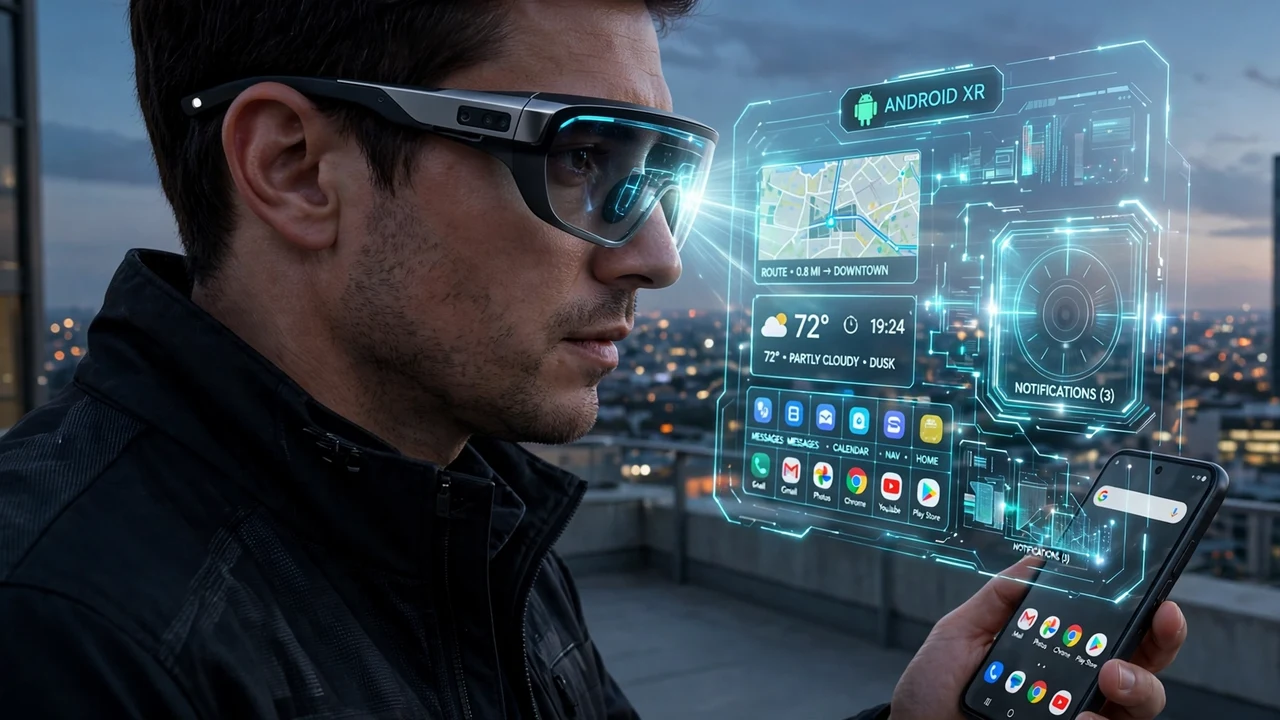
Google confirmed at I/O that the first consumer Android XR models target fall 2026 in select markets. That statement sets a broad window and an important qualifier: fall 2026 is a target, not a guarantee for every market, and select markets means availability is expected to be limited at first rather than worldwide on day one. Google has not, in the facts covered here, confirmed a final launch date, a price, or a supported-phone list for a specific consumer model.
Samsung has announced Intelligent Eyewear, built on Android XR, with designs from Gentle Monster and Warby Parker. Eyewear-brand involvement signals Samsung is treating glasses as everyday public wear, not only a demonstration. The product has also appeared in regulatory listings, a normal step before hardware can be sold, but a listing alone does not confirm a price, a release date, or final specifications.
A separate example, not the Samsung product
Do not confuse Samsung’s product with other Android XR glasses announced separately. One such example is XREAL AURA, wired XR glasses powered by Android XR with a 70-degree field of view and the Gemini assistant. Orders for XREAL AURA have opened in the United States, Canada, and South Korea, with Japan pre-orders on November 2.
XREAL AURA is useful only as evidence that Android XR is not purely theoretical: at least one Android XR glasses product has reached the ordering stage in some markets. It is not Samsung Intelligent Eyewear, and its status should not be transferred to Samsung’s glasses. Each product will have its own price, availability, and requirements when its maker announces them.
Why the reporting differs on timing
Some outlets have pointed to November as a possible window for further news or availability, while SammyGuru mentioned December for the United States and Korea. Those reports should be read as unconfirmed reporting, not fact. Different outlets may rely on different sources, markets, or products, and none of the timing claims covered here has been confirmed as a final launch date by Google or Samsung. Watch for a direct announcement or a product page with a price in your market, and treat November and December as possibilities, not dates to plan around.
Android XR glasses vs phone-only Gemini vs VR headset
Android XR glasses, a phone running Gemini on its own, and a virtual reality headset all involve artificial intelligence and displays, but they are designed for very different uses. The comparison below focuses on form and everyday role, not invented specifications. Where a detail has not been confirmed for a specific product, the table says so rather than guessing.
| Feature | Android XR glasses | Phone-only Gemini | VR headset |
|---|---|---|---|
| Form | Glasses-style wearable for daily life | Handheld phone, no wearable display | Large headset covering the eyes |
| Interaction | Through glasses, connected to a phone, with Gemini | Directly on the phone, by voice or text | Inside a fully immersive virtual environment |
| Use in public | Intended for everyday wear outside the home | Carried everywhere, but needs holding and looking at | Best suited to home or a dedicated space |
| Phone connection | Central to the model in Play services 26.42 | Not applicable; the phone is the device | Often standalone or paired with a separate system |
| Price and availability | Not confirmed for Samsung Intelligent Eyewear | Available via existing phones, subject to app availability | Varies by product; not the subject of this update |
The key point is not that one option is better than the others. Glasses aim to solve a different problem: hands-free, glanceable access to an assistant and information without pulling out a phone or shutting out the world. A phone already gives you Gemini anywhere, and a VR headset already gives you immersion. Glasses, if they succeed, would sit between those experiences, useful for short interactions throughout the day rather than long sessions.
What is confirmed and what is not
Because this topic is attracting fast-moving coverage, it helps to put confirmed facts and unconfirmed claims side by side. The table below uses only the facts supplied for this article and marks everything else as unconfirmed.
| Topic | Status | Detail |
|---|---|---|
| Play services 26.42 rollout | Confirmed | Began October 26, 2026; notes mention XR glasses connection |
| Silent earbud pairing | Confirmed | Added in 26.42; no notification during handshake |
| First consumer XR models | Confirmed target | Google at I/O: target fall 2026, select markets |
| Samsung Intelligent Eyewear | Confirmed announcement | Android XR; Gentle Monster and Warby Parker designs; regulatory listings |
| XREAL AURA, separate example | Confirmed as announced | Wired Android XR glasses; 70-degree view; Gemini; orders open in US, Canada, South Korea; Japan pre-orders November 2 |
| Price of Samsung glasses | Not confirmed | No price confirmed by Google or Samsung here |
| Final launch date | Not confirmed | No final date confirmed, despite November and December reporting |
| Supported-phone list | Not confirmed | No supported-phone list confirmed |
| Setup steps or companion app | Not confirmed | No setup steps or companion-app requirement confirmed |
| November or December timing | Unconfirmed reporting | Some outlets point to November; SammyGuru mentioned December for US and Korea |
Caution applies to the specific buying details, which matter most once you consider spending money.
What to do now
You do not need to take urgent action because of Play services 26.42. There is no confirmed product, price, or setup process to prepare for yet. Use this checklist to stay ready without falling for speculation.
- Keep your phone and Google Play services up to date through normal settings, and do not install unofficial files claiming to unlock glasses support early.
- Do not buy glasses, accessories, or companion apps based on rumoured prices, dates, or phone lists, since none has been confirmed for Samsung Intelligent Eyewear.
- Follow announcements from Google and Samsung directly for a final launch date, price, markets, and supported phones, rather than treating speculation as a release schedule.
- Keep Samsung Intelligent Eyewear and XREAL AURA separate: they are different products with different ordering status.
- If you use true wireless earbuds, note that silent pairing in 26.42 may make future pairing feel quieter, with no notification during the handshake.
- Wait for a real product page in your market before judging value, since comfort and daily usefulness cannot be judged from release notes.
What this means for Android users
For most Android users, Play services 26.42 changes nothing visible today, and that is normal. Its value lies in what it makes possible later. Google is building Android XR into the same background system that already connects phones to watches, earbuds, and cars. That should help glasses feel like a normal Android accessory, not a separate gadget.
It also suggests Google sees the phone, not the glasses alone, as the centre of the experience for now. Your accounts, assistant, connectivity, and apps already live on your phone, and glasses connected to that phone can draw on all of them.
What to watch next
The next meaningful signals will be a confirmed price, launch date, supported-phone list, and description of setup and daily use — not more background updates alone. Until then, the most accurate summary is simple: Play services 26.42 began rolling out on October 26, 2026, and it prepares Android phones to connect to Android XR glasses. Samsung has announced Intelligent Eyewear on Android XR, and XREAL AURA shows Android XR glasses are already reaching the ordering stage in some markets. Everything about price, final date, supported phones, and setup for Samsung’s glasses remains unconfirmed.
Frequently asked questions
What is Google Play services 26.42?
Google Play services 26.42 is a background update to the layer on Android phones that delivers features and connects phones to other devices without a full operating system update. It began rolling out on October 26, 2026, and its release notes mention support for connecting Android XR glasses to a phone, alongside silent pairing for true wireless earbuds.
Does Play services 26.42 mean my phone now works with Android XR glasses?
Not necessarily. The update adds background support for connecting Android XR glasses, but no supported-phone list has been confirmed. Receiving 26.42 alone does not confirm a specific pair will work with your phone, or when it will be available in your market.
When will Samsung Intelligent Eyewear launch, and how much will it cost?
Neither a final launch date nor a price has been confirmed. Google said at I/O that first consumer Android XR models target fall 2026 in select markets, and some outlets have pointed to November while SammyGuru mentioned December for the United States and Korea. Both timing reports are unconfirmed, and no price is confirmed.
Is XREAL AURA the same as Samsung Intelligent Eyewear?
No. XREAL AURA is a separate, already-announced example of wired XR glasses powered by Android XR, with a 70-degree field of view and the Gemini assistant. Orders have opened in the United States, Canada, and South Korea, with Japan pre-orders on November 2. Samsung Intelligent Eyewear is a different announced product, with Gentle Monster and Warby Parker designs, and its price and final launch details remain unconfirmed.
Do I need to do anything now to prepare for Android XR glasses?
No urgent action is needed. Keep your phone updated through normal settings, avoid unofficial files claiming to unlock glasses support, and wait for a direct announcement from Google or Samsung covering price, launch date, markets, supported phones, and setup steps. Do not decide a purchase based on unconfirmed prices, dates, or phone lists.



What do you think?
Share your experience or ask a question. A useful conversation starts with you.
Join the discussion