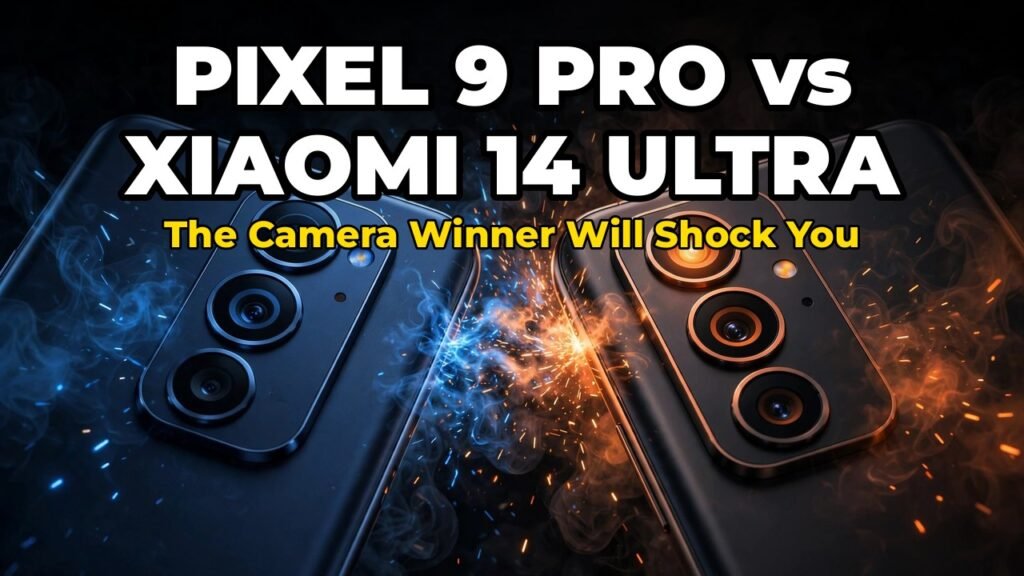
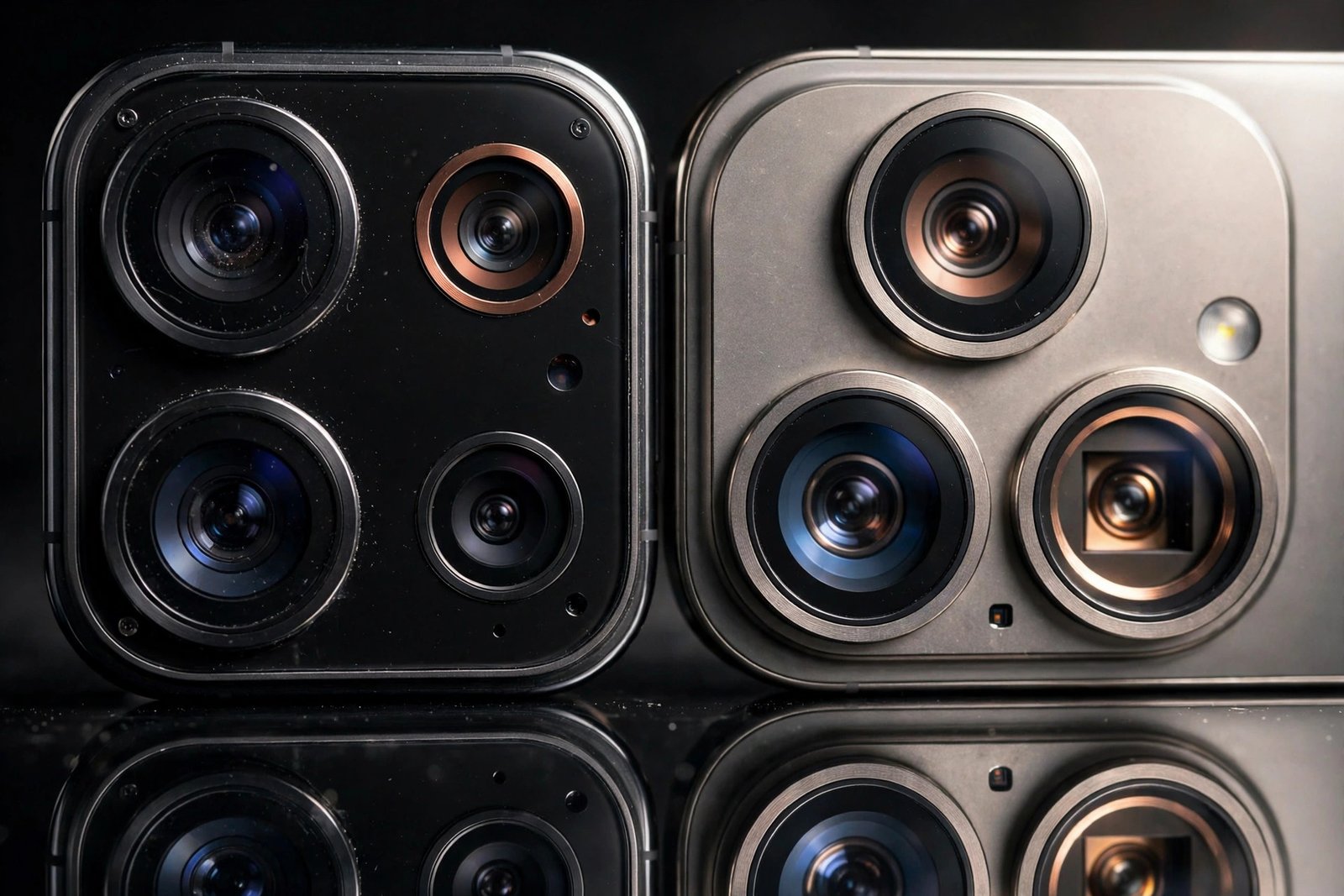
The flagship smartphone camera arena has evolved into an ideological clash between two fundamentally distinct engineering philosophies. On one side stands Google’s computational pioneer, the Pixel 9 Pro, leveraging state-of-the-art machine learning, on-device Gemini artificial intelligence, and proprietary multi-frame HDR+ algorithms to extract stunning imagery from compact, balanced sensors. On the opposing side stands Xiaomi’s optical juggernaut, the Xiaomi 14 Ultra, co-engineered with historic German optics legend Leica, packing a gargantuan 1-inch physical image sensor, stepless mechanical variable aperture blades, and quad-50MP dedicated telephoto periscopes that mimic professional cinema rigs.
For mobile photography enthusiasts, content creators, and prosumers searching for the ultimate pocket camera in 2026, comparing the Pixel 9 Pro vs Xiaomi 14 Ultra requires looking far beyond simple megapixel counts. It requires an in-depth mobile photography comparison examining the physical advantages of a 1-inch sensor camera phone versus the algorithmic consistency of Google, evaluating the artistic rendering differences in Leica vs Google computational photography, and benchmarking real-world portraiture, low-light nightscapes, dynamic zoom ranges, and cinematic video workflows. This exhaustive technical shootout analyzes both camera flagships based on published optical specifications, lab sensor metrics, and extensive professional photography reviews.
Pricing & Regional Availability Notice: Manufacturer retail prices, bundled photography kit accessories, and regional cellular band compatibility (specifically Xiaomi’s availability in European and Asian markets versus Google’s broad North American carrier distribution) reflect official vendor disclosures at publication. Pricing and international warranty terms fluctuate over time; verify live commercial terms directly with authorized retailers.
Opposing Philosophies: Algorithmic Magic vs Optical Dominance
To appreciate how these two flagships capture light, one must understand their underlying design architectures:
Google Pixel 9 Pro: The Computational Master
Google’s strategy has always prioritized software over raw physical sensor size. The Pixel 9 Pro utilizes a high-quality 50MP primary sensor (1/1.31-inch format) paired with the customized Google Tensor G4 processor. When you tap the shutter button, the camera captures up to 15 underexposed and overexposed frames in a fraction of a second, aligning and fusing them at the sub-pixel level.
Google’s algorithms excel at shadow noise suppression, scientific skin tone fidelity (via Real Tone datasets), and zero-shutter-lag point-and-shoot reliability. You can be walking, riding in a vehicle, or capturing a squirming toddler in dim lighting, and the Pixel’s computational pipeline will deliver a tack-sharp, evenly exposed image with virtually zero thought required from the user.
Xiaomi 14 Ultra: The Purist Photographic Rig
Xiaomi and Leica approach mobile imaging from the perspective of traditional analog camera craftsmanship. Rather than relying heavily on artificial machine learning processing to "fake" dynamic range and depth of field, the Xiaomi 14 Ultra relies on raw optical physics.
Its primary camera houses Sony’s massive 50MP LYT-900 1-inch sensor with 3.2μm large 4-in-1 Super Pixels. More impressively, it features a physical, mechanical stepless variable aperture (f/1.63 to f/4.0) that physically opens and closes mechanical blades inside the lens barrel. This physical optical volume produces genuine, creamy optical bokeh (subject separation) and authentic light falloff that no software blur filter can replicate. Paired with Leica's proprietary Summilux glass lenses (which dramatically reduce optical ghosting and chromatic aberration), the Xiaomi 14 Ultra operates more like a professional Leica rangefinder than a standard mobile phone.
Comprehensive Hardware Camera Specifications Matrix
The table below provides a detailed head-to-head comparison of sensor formats, focal lengths, aperture mechanisms, and computational video features between the Pixel 9 Pro and the Xiaomi 14 Ultra.
Camera Metric | Google Pixel 9 Pro | Xiaomi 14 Ultra (Leica Co-Engineered) |
Primary Sensor Size | 1/1.31-inch (50 MP, 1.2μm pixel size) | 1.0-inch Sony LYT-900 (50 MP, 1.6μm / 3.2μm binned) |
Primary Lens Aperture | Fixed f/1.68 aperture (OIS) | Stepless Mechanical Variable Aperture (f/1.63 – f/4.0, OIS) |
Optics & Lens Glass | Standard high-transmission glass (Dual-LED flash) | Leica Vario-Summilux 8P aspherical high-transmittance glass |
Ultra-Wide Camera | 48 MP (1/2.55-inch, f/1.7, 123-degree FOV, Macro) | 50 MP (1/2.51-inch Sony IMX858, f/1.8, 122-degree FOV, Macro) |
Mid-Telephoto Camera | None (Relies on 2x in-sensor primary crop) | 50 MP Dedicated 3.2x Portrait Telephoto (75mm, f/1.8, OIS) |
Periscope Telephoto | 48 MP 5x Optical Periscope (f/2.8, OIS, up to 30x Super Res) | 50 MP 5x Optical Periscope (120mm, f/2.5, OIS, up to 120x) |
Front Selfie Camera | 42 MP with Phase Detection Autofocus (f/2.2) | 32 MP Fixed Focus (f/2.0) |
Color Science & Tuning | Google Real Tone & Computational HDR+ | Leica Authentic & Leica Vibrant Profiles |
Pro Video Capabilities | 8K 30fps (via cloud Video Boost), 4K 60fps HDR | 8K 30fps (all 4 rear lenses), 4K 120fps, 10-bit Log |
Hardware Photography Kit | No (Standard phone form factor) | Optional modular camera grip with shutter, zoom lever, & battery |
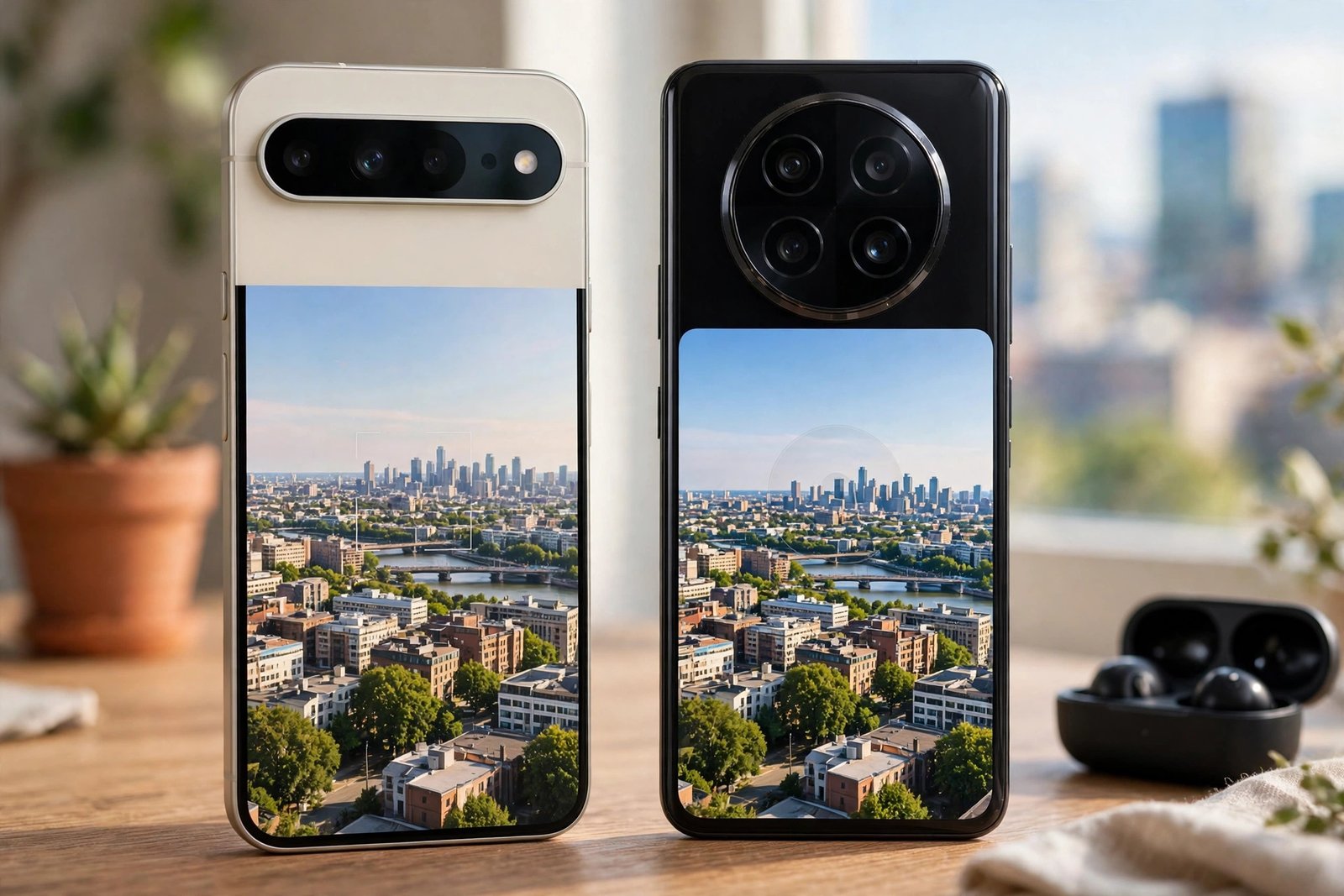
Primary Camera Shootout: The 1-Inch Advantage vs Real Tone Precision
Shooting with the primary wide lenses reveals the stark contrast in artistic personality between both smartphones.
1. Depth of Field and Natural Bokeh
When photographing close-up subjects (a cup of coffee, a watch on a wrist, a floral blossom), the Xiaomi 14 Ultra’s 1-inch LYT-900 sensor creates genuine, shallow optical depth of field. Background elements melt into soft, buttery bokeh naturally without engaging Portrait Mode software. Furthermore, if you are capturing a group of four friends standing at different distances, you can stop the physical aperture down to f/4.0 to ensure everyone’s eyes remain in tack-sharp focus—a feat impossible on the fixed-aperture Pixel.
The Pixel 9 Pro, with its 1/1.31-inch sensor, delivers respectable natural separation, but requires switching to software Portrait Mode to achieve heavy background blur. While Google’s depth mapping and edge segmentation are among the best in the industry, software blur can still exhibit occasional masking errors around wisps of fine hair or transparent eyeglasses.
2. Color Science: Clinical Accuracy vs Leica Mood
Google’s image tuning is legendary for its objective neutrality. Under the Pixel’s Real Tone algorithms, colors appear exactly as human eyes perceive them: whites are cleanly balanced, shadows are lifted with zero noise, and human skin tones across all ethnicities are rendered with scientific realism. It is the ultimate documentary camera.
Xiaomi, through its partnership with Leica, offers two distinct color profiles: Leica Authentic and Leica Vibrant. Leica Authentic intentionally avoids the flat, over-brightened "HDR look." It preserves dramatic, moody shadows, applies a subtle, organic optical vignetting around the frame edges, and delivers rich contrast reminiscent of classic street photography shot on 35mm film. For creative artists who want photographs with emotional weight and character right out of the camera, Xiaomi’s Leica tuning is intoxicating.
Telephoto Showdown: Google’s 5x Super Res vs Xiaomi’s Quad 50MP Array
In telephoto versatility, hardware architecture once again separates the contenders.
Xiaomi's Dual-Telephoto Versatility (3.2x and 5x)
Xiaomi equipped the 14 Ultra with two dedicated optical zoom lenses: a 75mm equivalent 3.2x portrait lens and a 120mm equivalent 5x periscope lens. Having a dedicated 3.2x lens is an immense advantage for human portraiture: 75mm is widely regarded by portrait photographers as the ideal flattering focal length, compressing facial features without perspective distortion. Furthermore, both telephoto lenses utilize "floating focus" groups, allowing them to focus down to macro distances of just 10cm and 30cm for stunning telephoto macro close-ups.
Google’s 5x Periscope and Super Res Zoom AI
The Pixel 9 Pro jumps directly from 1x to a 5x optical periscope (113mm equivalent). For intermediate 2x and 3x zoom, Google relies on in-sensor cropping from the primary 50MP sensor. While Google’s Super Res Zoom machine learning algorithms reconstruct detail admirably, the Xiaomi’s physical 3.2x optical glass retains distinctly sharper micro-textures and lower noise at portrait distances. However, at extreme distances (15x to 30x zoom), Google’s generative upscaling algorithms trade blows with Xiaomi, producing clean, legible architectural text and wildlife details.
Low-Light and Night Photography: Optical Ingress vs Night Sight
When the sun sets, both phones transform into nocturnal imaging beasts through different technical pathways.
- Xiaomi 14 Ultra: The sheer physical surface area of the 1-inch sensor, combined with a wide f/1.63 aperture, gathers massive volumes of raw photons. As a result, the Xiaomi does not need to hold a multi-second exposure: it snaps clean night shots in a fraction of a second, freezing moving streetlights and night pedestrians without motion blur. Night skies remain deep and atmospheric without artificial brightening.
- Pixel 9 Pro: Google’s Night Sight multi-frame stacking continues to work miracles. Even in near pitch-black rooms where human eyes struggle to see, the Pixel takes a 2-to-3-second exposure, perfectly aligning frames to reconstruct color, shadow detail, and starry skies with Astrophotography mode. However, the Pixel can occasionally over-brighten midnight scenes, making night look like late dusk.
Video Production: Video Boost vs Native 8K/120fps Cinema
Mobile videography presents another fascinating divergence in workflow priorities.
Google Video Boost and Night Sight Video
The Pixel 9 Pro captures excellent 4K 60fps video with rich HDR and class-leading electronic image stabilization (EIS). For ultimate fidelity, Google introduces Video Boost: your recorded video is uploaded to Google Cloud datacenter clusters, where massive neural networks process multi-frame temporal noise reduction, dynamic range color grading, and Night Sight lighting before sending the finalized, Hollywood-grade video back to your phone. It produces breathtaking results, but requires waiting minutes or hours for cloud processing.
Xiaomi 14 Ultra: Local Cinema Suite with Director Mode
Xiaomi processes everything locally on the device in real time. The 14 Ultra can record 8K at 30fps across all four rear camera lenses, and shoots stunning 4K at 120fps slow motion. It supports 10-bit Log recording with custom LUT import, allowing video colorists to grade footage natively in DaVinci Resolve. Furthermore, Xiaomi sells an optional Photography Kit: a physical modular camera grip that snaps onto the phone, adding a two-stage physical shutter button, a mechanical zoom lever, a customizable exposure wheel, and an integrated 1,500mAh auxiliary battery.

Frequently Asked Questions (FAQ)
Is the 1-inch sensor on the Xiaomi 14 Ultra genuinely better than the Pixel’s sensor?
From a pure optical physics perspective, yes. A 1-inch sensor has roughly 60% more surface area than the Pixel’s 1/1.31-inch sensor. This allows it to capture more physical light, produce shallower natural depth of field, and deliver higher signal-to-noise ratios in challenging lighting conditions before software processing even begins.
Which phone takes better point-and-shoot photos of moving kids and pets?
The Google Pixel 9 Pro is superior for unpredictable action. Google’s zero-shutter-lag pipeline and automated motion deblurring algorithms are specifically engineered to freeze moving subjects instantly. The Xiaomi 14 Ultra, while fast, can occasionally produce slight motion blur in dim indoor lighting if set to its wider apertures.
Does the Xiaomi 14 Ultra work on US carriers like Verizon, AT&T, and T-Mobile?
The Xiaomi 14 Ultra is primarily sold in Europe, the UK, and Asia. While it works reliably on T-Mobile’s sub-6GHz 5G and 4G LTE networks in the United States, it lacks full 5G band certification for AT&T and Verizon, and does not support millimeter-wave (mmWave) 5G. The Pixel 9 Pro offers full, certified carrier support across all US networks.
Which phone takes better selfie photos?
The Pixel 9 Pro takes significantly better selfies. Google upgraded the front camera to an ultra-sharp 42MP sensor equipped with Phase Detection Autofocus (PDAF), delivering crisp, focused self-portraits at any arm distance. The Xiaomi 14 Ultra uses a 32MP fixed-focus front camera that can look soft if you hold the phone too close or too far.
Can the variable aperture on the Xiaomi 14 Ultra be controlled manually in video?
Yes. In Xiaomi’s "Pro Video" and "Director Mode," you can smoothly adjust the mechanical aperture blades from f/1.63 to f/4.0 in real time while recording, allowing you to control depth of field and exposure without introducing shutter angle artifacts.
Does Google’s "Add Me" feature work on the Xiaomi 14 Ultra?
No. "Add Me"—a generative AI camera feature that seamlessly inserts the photographer into group shots by combining two exposures—is exclusive to Google Pixel smartphones running on-device Gemini models.
Final Verdict: Which Photography Champion Reigns Supreme?
The choice between the Pixel 9 Pro vs Xiaomi 14 Ultra comes down to whether you prioritize computational reliability or authentic optical craftsmanship:
- Choose the Xiaomi 14 Ultra If: You consider yourself a photographer first and a smartphone user second. You crave the organic, moody magic of Leica color science, the physical depth of a massive 1-inch sensor, stepless mechanical aperture control, dual portrait-and-periscope telephotos, and pro-grade 4K 120fps video recording with an optional physical camera grip.
- Choose the Google Pixel 9 Pro If: You want the most reliable, effortless point-and-shoot camera on the planet. You demand lifelike Real Tone skin color accuracy, flawless action capture of moving family and pets, class-leading front selfie autofocus, 7 years of Android operating system upgrades, and seamless US carrier network support.
Both devices represent the pinnacle of modern mobile imaging. Whether you lean toward Leica's mechanical soul or Google's computational intellect, you are holding one of the greatest optical achievements in consumer technology history.