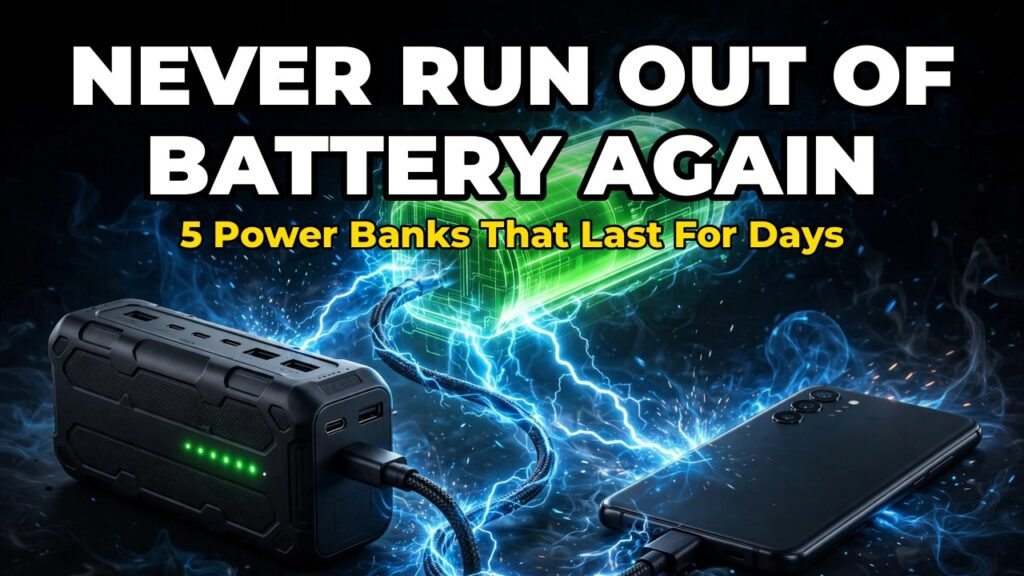
Modern Android flagship smartphones, foldables, and tablets are extraordinary computational powerhouses. They feature vibrant 120Hz LTPO OLED displays, power-hungry 5G modems, multi-core AI coprocessors, and desktop-class gaming GPUs. However, even with massive 5,000mAh internal batteries, power users, frequent business travelers, and outdoor photographers inevitably encounter the dreaded red low-battery warning midway through a demanding day. Whether you are navigating unfamiliar cities with continuous GPS mapping, capturing 4K 120fps video footage at a trade show, or using your smartphone as a mobile hotspot on a cross-country flight, access to dependable portable electricity is essential.
Fortunately, the portable charging ecosystem has undergone a monumental technological revolution thanks to the convergence of Gallium Nitride (GaN) semiconductors, high-density 21700 lithium cells, and the USB Power Delivery 3.1 Extended Power Range (EPR) standard. Today's premier power banks for Android are no longer heavy, slow-charging brick bricks that take all night to recharge. A modern 100W USB-C portable charger can rapidly charge a smartphone from 0% to 50% in twenty minutes while simultaneously delivering enough wattage to power a companion USB-C laptop or tablet.
However, selecting the optimal high-capacity battery pack requires navigating critical hardware specifications: verifying true Programmable Power Supply (PPS) protocol compliance for Samsung and Google fast-charging handshakes, evaluating thermal dissipation, inspecting real-time smart digital status displays, and ensuring the battery remains an officially certified airline approved battery pack that clears airport security checkpoints without confiscation. In this comprehensive editorial review, we evaluate the best high-capacity PPS fast charging power bank models available for Android users in 2026.
Editorial Note: TechVantageAPK evaluates mobile hardware based on verified technical benchmarks, electrical engineering laboratory teardowns, and real-world consumer testing. We do not accept sponsored affiliate placements. Hardware retail pricing referenced in this guide reflects public vendor rates at publication; prices may change — check official retailers for current market rates.
The Physics of Fast Charging: Why Protocol Compatibility Matters
To avoid purchasing an expensive power bank that charges your flagship phone at agonizingly slow speeds, users must understand the electrical charging protocols governing modern Android hardware:
1. USB-PD 3.0 vs USB-PD 3.1 (EPR)
Standard USB Power Delivery 3.0 caps power delivery at 100 Watts (20 Volts at 5 Amps). The newer USB-PD 3.1 Extended Power Range (EPR) specification unlocks high-voltage charging profiles up to 140W and 240W (up to 48V). While an Android smartphone will not draw 140W, a PD 3.1 power bank can output 100W to a laptop while simultaneously supplying 45W to your phone through secondary ports without power throttling.
2. The Necessity of Programmable Power Supply (PPS)
This is the single most important specification for Samsung Galaxy and Google Pixel owners. Standard fixed-voltage USB-PD steps between 5V, 9V, 15V, and 20V. Samsung's "Super Fast Charging 2.0" (45W) and Google's 30W/37W fast-charging algorithms demand PPS. Programmable Power Supply allows the smartphone's internal fuel gauge to dynamically negotiate microscopic voltage adjustments in 20-millivolt increments (e.g., requesting 9.6V at 4.5A). If a 100W power bank lacks PPS support, a Galaxy S24 Ultra or Pixel 9 Pro will fall back to basic 15W charging, tripling your recharge time.
3. TSA and FAA Airline Battery Limits (The 100Wh Rule)
Global aviation security agencies (including the US FAA, TSA, and international ICAO) strictly prohibit lithium battery packs exceeding 100 Watt-hours (Wh) in carry-on luggage without prior airline approval, and ban them entirely from checked baggage. To calculate Watt-hours: multiply the battery's nominal voltage (typically 3.7V for lithium-ion cells) by its milliamp-hour (mAh) capacity and divide by 1,000. Therefore, a 27,000mAh battery pack equates to approximately 99.9Wh—the absolute legal maximum allowed on commercial passenger flights worldwide.
Top 5 High-Capacity Power Banks for Android in 2026
We evaluated the leading portable chargers across sustained output wattage, PPS compatibility, battery cell density, thermal efficiency, and digital telemetry displays:
1. Anker Prime 27,650mAh Power Bank (250W) — The Undisputed King of Power
Anker's flagship Prime 27,650mAh battery pack (formerly known as the Anker 737 / Prime series) represents the pinnacle of consumer portable power engineering.
- Electrical Architecture: Delivers a staggering 250W of combined multi-port output, featuring two USB-C PD 3.1 ports (capable of individual 140W output) and one high-power USB-A port. Full dual-channel PPS support guarantees maximum 45W Super Fast Charging on Samsung Galaxy flagships.
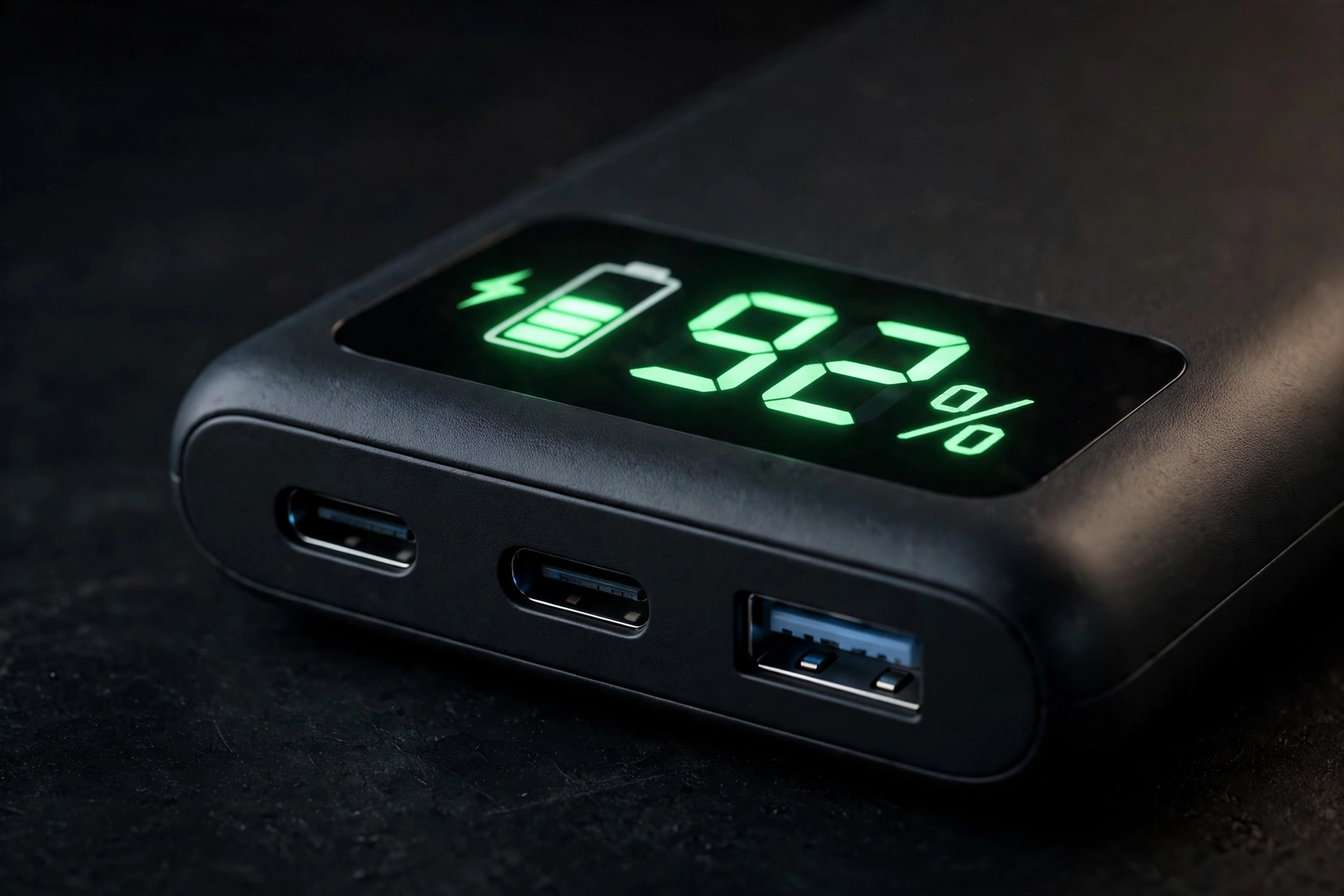
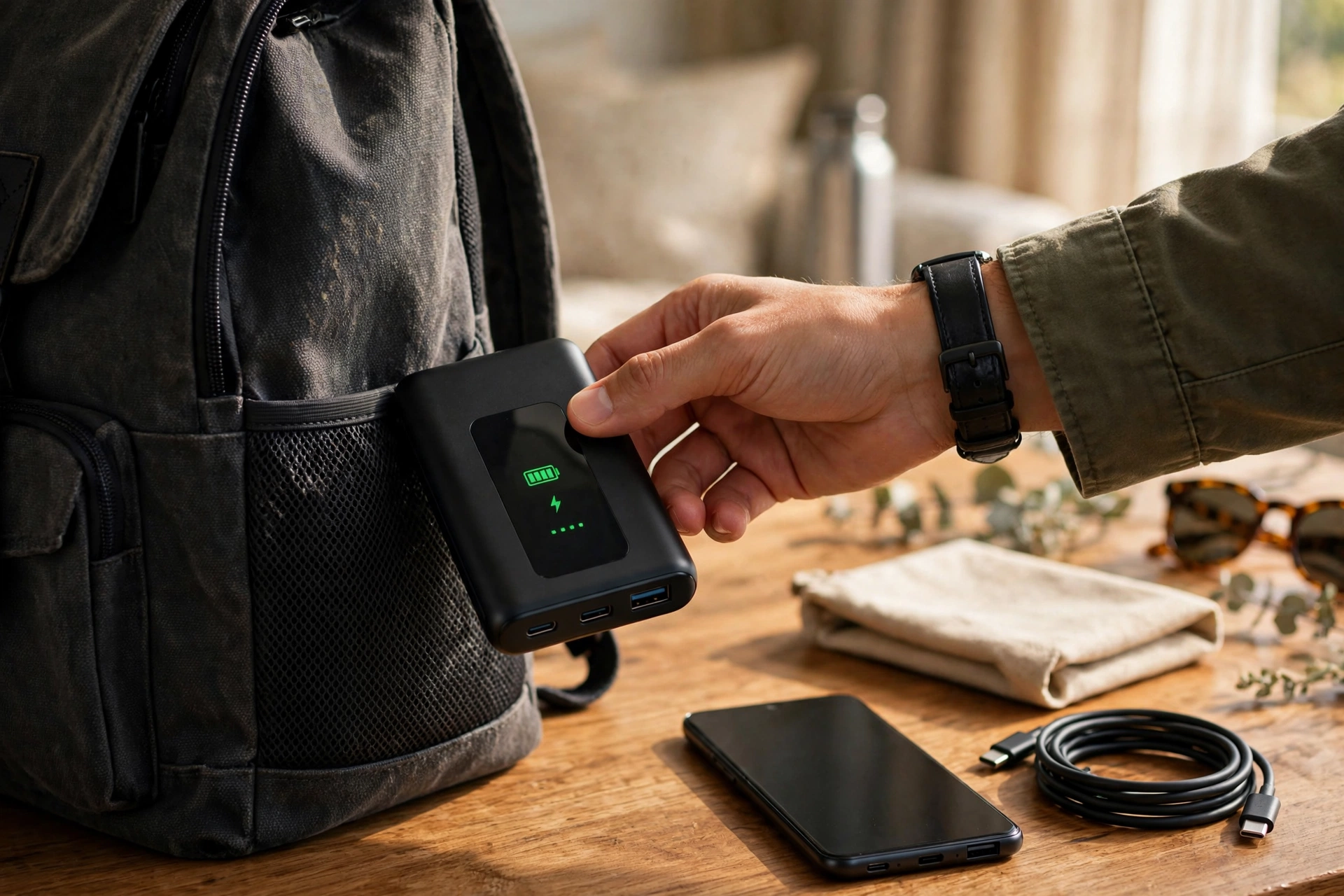
- Smart Digital Display: An integrated full-color TFT display provides real-time electrical telemetry: input and output wattage per port, remaining battery percentage, battery cell temperature in Celsius, total cycle count, and precise time-to-full recharge estimates.
- Recharge Speed: Can be recharged from 0% to 100% in an astonishing 37 minutes when connected to a 140W wall charger or Anker's companion charging base.
- Airline Compliant: Exactly 99.54Wh, legally compliant for carry-on luggage across all international airlines.
2. CMF by Nothing 65W GaN Power Bank — Minimalist Design and Value
CMF (Nothing's sub-brand) brings bold industrial design and high-efficiency GaN power to the sub-$60 category.
- Core Capabilities: Houses a 20,000mAh cell capacity delivering 65W single-port USB-C PD output with comprehensive PPS fast-charging support for Pixel, Galaxy, and Motorola devices.
- Ergonomics: Lightweight pocketable form factor with a matte textured grip, lanyard anchor, and clean LED power indicators.
- Value Proposition: Outstanding price-to-wattage ratio, making it the premier budget-conscious everyday carry battery.
3. Shargeek 100 (formerly Storm 2) — The Cyberpunk Translucent Showpiece
For enthusiasts who appreciate raw electronics, Shargeek's iconic transparent chassis showcases internal circuit boards, battery cells, and heatsinks.
- Core Capabilities: 25,600mAh capacity (93.5Wh) delivering 100W USB-C PD output, DC barrel port output (adjustable from 3V to 25V for specialized hardware), and dual USB ports.
- IPS Energy Management OS: Features an advanced graphical operating system displaying real-time voltage/current curves, battery life health percentages, and thermal distribution across individual cell banks.
4. Ugreen Nexode 20,000mAh 130W Power Bank — The Compact Commuter Favorite
Ugreen's Nexode series emphasizes ergonomic portability without sacrificing multi-device charging muscle.
- Core Capabilities: Compact vertical column footprint delivering 100W from port 1 and 30W from port 2 simultaneously, allowing you to fast-charge a laptop and Android phone simultaneously.
- TFT Display: Integrated multi-color digital screen displaying input/output wattages and battery level.
5. Baseus Blade HD 100W Ultra-Thin Power Bank — The Laptop Bag Specialist
While most high-capacity batteries are thick cylinders, Baseus engineered the Blade HD as an ultra-slim, flat rectangular slate measuring just 0.7 inches thick.
- Core Capabilities: 20,000mAh capacity delivering 100W USB-C output with dual USB-C and dual USB-A ports.
- Form Factor Advantage: Slides effortlessly into thin laptop sleeves, briefcase pockets, or backpack document sleeves where bulky round power banks bulge awkwardly.
High-Capacity Power Bank Comparison Matrix
Power Bank Model | Capacity (mAh / Wh) | Max Single Port Output | PPS Fast Charging | Digital Telemetry Screen | Airline Approved |
Anker Prime 27,650mAh | 27,650mAh / 99.5Wh | 140W (PD 3.1) | Yes (Full 45W PPS) | Full-Color TFT Display | Yes (TSA Max Limit) |
CMF by Nothing 65W | 20,000mAh / 74Wh | 65W (PD 3.0) | Yes (45W PPS) | LED Dot Indicators | Yes |
Shargeek 100 (Storm 2) | 25,600mAh / 93.5Wh | 100W (PD 3.0 + DC) | Yes (PPS Supported) | Full IPS Energy OS | Yes |
Ugreen Nexode 130W | 20,000mAh / 72Wh | 100W (PD 3.0) | Yes (Full PPS) | Smart Digital Screen | Yes |
Baseus Blade HD 100W | 20,000mAh / 74Wh | 100W (PD 3.0) | Yes (PPS Supported) | Digital LED Readout | Yes (Ultra-Thin) |
Battery Health, Cable Selection, and Safe Operating Hygiene
To ensure your high-capacity power bank lasts for hundreds of charge cycles without thermal degradation, adhere to these four operational standards:
1. Always Pair with Certified 100W / 240W E-Marker Cables
A 100W power bank cannot deliver fast charging if paired with a cheap 60W-rated cable. USB-C cables carrying more than 60W (3 Amps) require an integrated "E-Marker" microchip inside the cable connector that certifies to the charger and phone that the wire can safely handle 5 Amps. Always use 100W or 240W certified cables to unlock maximum charging speeds.
2. The Dangers of Thermal Insulated Charging
Fast-charging an Android phone while both the phone and power bank are zipped inside a backpack, purse, or jacket pocket traps heat. Modern high-capacity battery packs generate noticeable warmth during 65W+ output. Trapped heat accelerates lithium-ion degradation, damages internal circuits, and forces power banks to trigger thermal emergency shutdowns. Always charge devices in well-ventilated open air.
3. Maintaining Long-Term Storage Voltage (The 50% Rule)
If you purchase a high-capacity power bank for seasonal camping or emergency weather preparedness, never store it in a closet at 0% or 100% capacity for months. Lithium cells experience maximum chemical stress when fully saturated or completely depleted. Discharge or charge the pack to approximately 50% to 60% capacity before long-term storage, and top it up once every six months.
Cell Chemistry Standards: 21700 Cylindrical Cells vs Prismatic Lithium-Polymer
The internal cell architecture of a portable power bank dictates its cycle longevity, thermal resilience, and volumetric energy density.
1. High-Density 21700 Lithium-Ion Cells
Premier high-capacity power banks (such as Anker Prime and Shargeek) have abandoned standard pouch cells in favor of cylindrical 21700 lithium-ion cells—the exact same cell format utilized in modern electric vehicles (EVs). Compared to older 18650 cells, 21700 cells offer 50% higher capacity per cell, superior thermal dissipation jackets, and enhanced structural rigidity, resisting physical punctures and swelling under high-current 100W+ discharges.
2. Hardware Safety Certifications (UL 2056 and CE Compliance)
Because lithium-ion packs store immense chemical energy, never purchase unbranded power banks from sketchy online marketplaces. Always verify that the battery pack carries official UL 2056 or IEC 62133 safety certifications. These rigorous testing standards mandate multi-stage fail-safes: over-voltage protection, short-circuit cutoffs, dual NTC thermal sensors, and fire-retardant V-0 polycarbonate outer enclosures.

Frequently Asked Questions (FAQ)
Can I bring a 27,000mAh power bank on an airplane?
Yes. Federal Aviation Administration (FAA) and international airline regulations permit lithium-ion battery packs up to 100 Watt-hours (Wh) in carry-on luggage without prior carrier approval. A 27,000mAh battery operating at 3.7V nominal voltage equals 99.9Wh, which is legally compliant for carry-on travel. Never pack power banks in checked luggage.
Why does my power bank charge my phone slower when two devices are plugged in?
Most multi-port power banks share electrical power channels. When a second device is plugged in, the internal power management circuit renegotiates power delivery, dividing available wattage (e.g., dropping a 100W single port down to a 65W + 30W split) to protect internal circuits from over-current damage.
What does Pass-Through Charging mean?
Pass-Through Charging allows the power bank to recharge its internal battery cells while simultaneously outputting power to your connected smartphone. High-end battery packs (like Anker Prime and Shargeek) support clean pass-through charging without overheating.
Will a 100W power bank damage a phone that only accepts 25W?
No. Power is drawn by the phone, not forced by the charger. USB Power Delivery involves an intelligent digital handshake: a 100W charger communicates with your phone, the phone requests its maximum safe intake (e.g., 25W), and the charger supplies exactly 25W.
How many times can a 20,000mAh power bank charge a typical Android smartphone?
A standard Android flagship features a 5,000mAh battery. Due to electrical voltage conversion losses (converting 3.7V internal battery voltage up to 9V/15V USB-PD and back down to phone battery voltage), portable power banks operate at roughly 70% to 80% practical efficiency. A 20,000mAh pack will typically deliver between 2.8 and 3.2 full charges to a 5,000mAh phone.
What is Low-Current Mode on modern power banks?
Standard power banks automatically shut off if power draw drops below a certain threshold (assuming the device is fully charged). Low-Current Mode (activated by double-pressing the power button on Anker/Ugreen packs) keeps the port active with a trickle current, allowing you to charge low-power accessories like wireless earbuds, smartwatches, and fitness bands without the power bank shutting off prematurely.
Conclusion: Uncompromised Portable Power
In our demanding digital world, running out of mobile power during critical moments is a completely preventable headache. Modern power banks for Android have evolved into compact, intelligent energy stations capable of keeping your entire mobile tech suite energized anywhere on Earth.
By selecting a high-capacity, PPS fast charging power bank certified under the 100Wh airline limit—such as the formidable Anker Prime 27,650mAh or the pocket-friendly CMF 65W GaN—you gain total energetic independence, ensuring your Android devices remain charged, responsive, and ready for action in 2026.