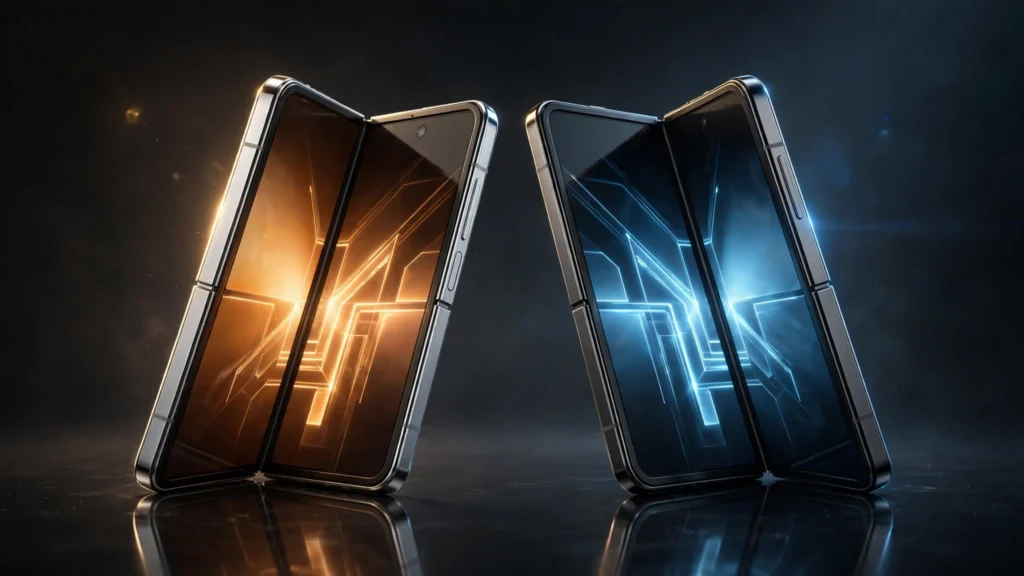
The book-style foldable smartphone category has transitioned from an experimental engineering curiosity into a mature, high-performance computing platform. What began as fragile prototypes plagued by bulky hinges and vulnerable plastic screens has evolved into sleek, water-resistant productivity powerhouses capable of replacing both a flagship smartphone and an enterprise tablet in a single pocketable package. In 2026, the battle for foldable supremacy is commanded by two tech heavyweights: the Samsung Galaxy Z Fold 6 and the Google Pixel 9 Pro Fold.
Samsung represents the veteran pioneer. With six generations of foldable manufacturing refinements, the Galaxy Z Fold 6 showcases razor-sharp industrial design, proven hinge durability, integrated S Pen digitizer support, and the most sophisticated multi-window desktop multitasking software on the market. Conversely, Google has radically redesigned its foldable philosophy with the Pixel 9 Pro Fold. By adopting a dramatically thinner chassis, an ultra-expansive 8-inch inner canvas, a standard smartphone aspect ratio on the cover screen, and Google's renowned computational photography pipeline, the Pixel makes an aggressive bid to unseat Samsung's crown.
For high-end consumers, business executives, and power users preparing to invest nearly two thousand dollars into a next-generation foldable, choosing between these flagship titans requires analyzing critical real-world trade-offs. In this comprehensive Galaxy Z Fold 6 vs Pixel 9 Pro Fold editorial comparison, we evaluate both devices across hardware ergonomics, display engineering, multitasking software, silicon performance, and camera capabilities based on verified manufacturer specifications, lab durability benchmarks, and extensive user community evaluations to crown the best foldable phone 2026 has to offer.
Editorial Note: Retail pricing, carrier trade-in promotions, and regional warranty programs fluctuate regularly—prices and terms may change, so always verify current details on official Samsung and Google storefronts. TechVantageAPK provides strictly educational consumer hardware analyses and does not distribute or sell physical mobile devices.
Design, Dimensions, and Ergonomics: The Battle of Form Factors
The most immediate and striking divergence between these two foldables lies in their physical proportions and exterior pocketability.
Pixel 9 Pro Fold: The Thinness and Aspect Ratio Revolution
Google executed a complete industrial redesign for its second-generation foldable. The Pixel 9 Pro Fold is astonishingly thin, measuring just 10.5 mm folded and a featherweight 5.1 mm unfolded. When closed, it feels remarkably like a conventional slab smartphone in the pocket rather than two phones sandwiched together.
Crucially, Google abandoned the short, passport-style cover screen of the original Pixel Fold in favor of a standard 6.3-inch 20:9 outer display. When closed, typing on the Pixel 9 Pro Fold feels completely natural: your thumbs navigate a standard-width keyboard without cramped letter keys. Opening the device reveals an enormous, class-leading 8.0-inch Super Actua Flex inner display—the largest inner canvas available on any mainstream foldable smartphone.
Galaxy Z Fold 6: Sculpted Precision and Symmetrical Refinement
Samsung has refined its established industrial design language, introducing sharp, squared-off corners, completely flat matte armor-aluminum rails, and a svelte 12.1 mm folded profile weighing roughly 239 grams (making it lighter than the Pixel's 257 grams). While slightly thicker than Google's offering, Samsung's hinge engineering allows the device to snap shut with satisfying, airtight precision.
Samsung widened the cover screen on the Z Fold 6 to 6.3 inches with a 22.1:9 aspect ratio. While significantly more comfortable than the narrow "remote control" screens of earlier Fold generations, it remains slightly narrower than Google's outer display. However, the narrower profile makes the Galaxy exceptionally easy to grip securely in one hand while commuting on crowded trains.
Display Quality, Crease Visibility, and Hinge Engineering
A foldable smartphone lives and dies by the quality of its folding glass and the mechanical resilience of its hinge.
Display Technology Comparison
Display Specification | Samsung Galaxy Z Fold 6 | Google Pixel 9 Pro Fold |
Cover Display | 6.3" Dynamic AMOLED 2X (1–120Hz) | 6.3" Actua OLED (60–120Hz) |
Inner Folding Display | 7.6" Dynamic AMOLED 2X (1–120Hz) | 8.0" Super Actua Flex LTPO (1–120Hz) |
Peak Brightness (Inner) | 2,600 nits | 2,700 nits |
Stylus / Pen Support | Yes (S Pen Fold Edition) | No Stylus Support |
Water / Dust Rating | IP48 (Water + Limited Particle) | IPX8 (Water Submersible) |
The Crease Factor and Hinge Mechanisms
Both manufacturers utilize modern "teardrop" (waterdrop) hinge architectures that allow the flexible Ultra-Thin Glass (UTG) to bend in a gentle internal radius rather than a sharp crease, eliminating screen gaps when folded shut.
- Galaxy Z Fold 6: Samsung's dual-rail hinge mechanism is extraordinarily rigid and smooth. It holds any angle between 30 and 150 degrees effortlessly in "Flex Mode." The center crease has been reduced in tactile depth compared to the Fold 5, though it remains slightly noticeable under direct angled lighting.
- Pixel 9 Pro Fold: Google's multi-gear fluid hinge allows the device to unfold completely 180 degrees flat with zero residual spring tension. Because of the vast 8-inch screen estate, the center crease is wider and shallower, making it virtually imperceptible when viewing video or documents head-on.
Dust and Particle Durability (IP48 vs IPX8)
A major milestone in foldable engineering is Samsung's achievement of an official IP48 certification on the Z Fold 6. While both phones feature IPX8 water resistance (surviving immersion in 1.5 meters of fresh water for 30 minutes), Samsung's IP48 rating certifies protection against solid foreign objects greater than 1mm (such as small pebbles or thick dirt particles), backed by internal microscopic sweeper brushes inside the hinge housing.

Software and Multitasking: One UI vs Pixel Fold Experience
Hardware provides the canvas, but software dictates whether a foldable functions as a genuine productivity tool or merely an oversized mobile browser. In this Samsung vs Google foldable showdown, software approaches diverge dramatically.
Samsung One UI 6.1.1: The Undisputed Multitasking Titan
Samsung's six-year head start in foldable software optimization is immediately apparent in One UI. The Galaxy Z Fold 6 is an absolute productivity monster:
- Three-App Split Screen: Run three active applications simultaneously on the inner canvas in customized grid configurations, with a fourth application floating in a resizable picture-in-picture window.
- Persistent Taskbar & App Pairs: A desktop-style taskbar anchors along the bottom of the screen, allowing instant drag-and-drop app launching. Save frequently used split-screen combinations (e.g., Slack + Google Sheets + Calculator) as single-tap icon shortcuts.
- S Pen Support: While the S Pen must be purchased separately or housed in a case, having active digitizer stylus support transforms the 7.6-inch screen into an elite digital notebook for handwritten meeting notes, document annotation, and precision photo retouching.
- Samsung DeX: Connect to an external monitor via USB-C or wirelessly to launch a full desktop computer environment.
Google's Pixel Fold Software: Clean, Elegant, and Content-First
Google takes a more minimalist, user-friendly approach with its refined Android 15 foldable software:
- Dual-App Multitasking: Supports running two full applications side-by-side. While it lacks Samsung's three-app split mode, running two full apps on the expansive 8-inch canvas provides immense, readable screen real estate.
- App Pairs Shortcut: Android 15 introduces native App Pairs, allowing you to save your favorite dual-screen splits to your home screen with a single tap.
- Optimized Google Suite: Google apps (Gmail, YouTube, Google Docs, Google Maps, Google Meet) feature gorgeous dual-pane split layouts that feel like native tablet software.
- Dual-Screen Interpreter Mode: Utilizes both the inner and outer displays simultaneously during live conversations—showing foreign text to the other person on the outer screen while displaying your translated text on the inner screen.
Silicon Performance, Thermals, and Battery Life
Under the hood, raw compute power and battery management determine sustained daily reliability.
Performance Benchmarks
- Galaxy Z Fold 6: Powered by the Snapdragon 8 Gen 3 for Galaxy with 12GB of RAM. In raw synthetic GPU benchmarks and heavy 3D mobile gaming, Samsung's silicon holds a decisive lead, maintaining higher average frame rates and superior power efficiency during extended workloads.
- Pixel 9 Pro Fold: Powered by Google's custom Tensor G4 silicon paired with a massive 16GB of LPDDR5X RAM. Google prioritized on-device AI model execution (Gemini Nano) and responsive daily app multitasking. While daily navigation feels silky smooth, sustained heavy 3D gaming will throttle frame rates earlier than the Snapdragon platform.
Battery Capacity and Charging Speeds
- Galaxy Z Fold 6: Houses a 4,400 mAh dual-cell battery. Despite the relatively modest capacity, Samsung's Snapdragon efficiency delivers a solid 7 to 8 hours of screen-on time, comfortably lasting a full workday. Wired charging tops out at 25W, with 15W wireless charging.
- Pixel 9 Pro Fold: Houses a slightly larger 4,650 mAh battery. Powering the massive 8.0-inch inner display requires noticeable energy, resulting in roughly 6.5 to 7.5 hours of active screen time. Wired charging is rated at 21W, with standard wireless charging.

Camera Systems: Computational Realism vs Versatile Zoom
Historically, foldables have compromised on camera hardware due to ultra-thin chassis constraints. While neither phone matches the extreme camera sensors of the Galaxy S24 Ultra or Pixel 9 Pro slab phones, both deliver flagship-grade photography.
Camera Hardware Specifications
Camera | Galaxy Z Fold 6 | Pixel 9 Pro Fold |
Main Wide | 50 MP, f/1.8, Dual Pixel AF, OIS | 48 MP, f/1.7, Quad PD, OIS |
Ultra-Wide | 12 MP, f/2.2, 123° FOV | 10.5 MP, f/2.2, 127° FOV, Macro Focus |
Telephoto | 10 MP, f/2.4, 3x optical zoom, OIS | 10.8 MP, f/3.1, 5x optical zoom, OIS |
Cover Selfie | 10 MP, f/2.2 | 10 MP, f/2.2 |
Inner Under-Display | 4 MP Under-Display Camera (UDC) | 10 MP Hole-Punch Camera |
Real-World Photographic Aesthetic
- Google's Photographic Edge: The Pixel 9 Pro Fold is the superior point-and-shoot camera. Google's computational HDR+ pipeline, Real Tone skin balancing, and Zero Shutter Lag capture sharp, candid photos of moving children and pets with effortless consistency. Furthermore, its dedicated 5x optical periscope lens delivers dramatically sharper telephoto portraits and distant landscape shots than Samsung's 3x optical sensor.
- Samsung's Video and Under-Display Tech: The Galaxy Z Fold 6 excels in video stabilization, 8K recording capability, and vibrant color saturation. Additionally, Samsung utilizes an Under-Display Camera (UDC) on the inner screen, hiding the camera beneath active pixels for an uninterrupted full-screen movie viewing experience, whereas the Pixel features a visible hole-punch camera cutout in the top corner of its inner display.

Frequently Asked Questions (FAQ)
Which foldable has a less noticeable screen crease?
The Google Pixel 9 Pro Fold exhibits a shallower, wider crease that is generally less noticeable when viewing content head-on. Samsung's crease on the Z Fold 6 is slightly narrower and deeper, making it more tactile when dragging your finger across the center, though both displays look virtually seamless during direct video playback.
Can I use an S Pen on the Google Pixel 9 Pro Fold?
No. The Pixel 9 Pro Fold does not incorporate an active digitizer layer and does not support stylus or pen input. If handwriting, precision sketching, and document signing are essential to your workflow, the Galaxy Z Fold 6 is the only choice between the two.
Do both phones offer 7 years of Android software updates?
Yes. Both Google and Samsung provide an industry-leading commitment of 7 full years of major Android OS upgrades and monthly security patches, ensuring that both foldables remain supported, secure, and feature-rich through 2031.
Are foldable phones durable enough for everyday use in 2026?
Yes. Modern foldables have overcome the fragility of early generations. Both devices feature water resistance, reinforced aluminum frames, and durable Ultra-Thin Glass rated for over 200,000 folds (the equivalent of folding the phone 100 times per day for more than five years). Samsung also offers IP48 limited dust and particle protection.
Can you use the outer screen for regular smartphone tasks?
Yes, absolutely. The Pixel 9 Pro Fold excels here with its standard 20:9 aspect ratio, functioning identically to a standard flagship phone when closed. The Galaxy Z Fold 6 is slightly narrower (22.1:9), which facilitates comfortable one-handed gripping but can feel slightly tight for two-thumb typing.
Which foldable is better for mobile gaming?
The Galaxy Z Fold 6 is the superior mobile gaming platform. Powered by the Snapdragon 8 Gen 3 for Galaxy, it delivers higher sustained frame rates in graphically demanding titles like Genshin Impact and features superior thermal dissipation over extended gaming sessions.
Conclusion: Crown the Foldable Champion for Your Needs
Both the Samsung Galaxy Z Fold 6 and Google Pixel 9 Pro Fold represent astonishing triumphs of modern mobile engineering. Your ideal selection depends upon how you intend to utilize that transformative inner canvas:
Choose the Google Pixel 9 Pro Fold if:
- You prioritize ultra-thin hardware design (10.5 mm folded) and a standard, comfortable cover screen.
- You want the largest possible inner tablet canvas (8.0 inches) with a less noticeable crease.
- You demand the best camera system on a foldable, featuring unmatched point-and-shoot realism and a 5x optical periscope lens.
- You appreciate clean, bloatware-free Android software with Day-One updates.
Choose the Samsung Galaxy Z Fold 6 if:
- You are an unapologetic power user who demands 3-app split-screen multitasking and Samsung DeX desktop capability.
- Active stylus input (S Pen) is essential for your digital note-taking or design workflow.
- You want maximum gaming horsepower with the Snapdragon 8 Gen 3 chipset.
- You value certified IP48 particle and dust resistance for added mechanical peace of mind.
Whichever flagship you choose, you are stepping into the future of personal mobile computing—enjoying the unmatched versatility of having a powerful smartphone and a full-featured tablet unified seamlessly in your pocket.