In a smartphone market increasingly dominated by massive, pocket-straining "Ultra" and "Pro Max" devices that push past 6.8 inches and weigh over half a pound, finding a premium smartphone that comfortably fits in one hand has become a rare delight. For millions of consumers, two-handed operation is an ergonomic nuisance. They want a device that slips effortlessly into jeans pockets, can be operated with one thumb while holding a subway railing, and yet refuses to compromise on display brilliance, camera optics, or silicon processing power.
In 2026, the battle for the title of best small Android phone is an electrifying clash between two industry titans: the Google Pixel 9 and the Samsung Galaxy S24. Both manufacturers have priced their base flagships starting around $799, and both offer the identical industry-leading commitment: seven full years of major Android operating system upgrades and security patches. Yet, despite their shared compact ambitions and identical support horizons, their underlying hardware and software design philosophies diverge dramatically.
Google positions the Pixel 9 as the consummate ambient AI flagship—boasting a radical modern industrial redesign, generous 12GB of standard RAM, a 50MP primary camera powered by Google's legendary HDR+ computational imaging, and an expansive 4,700mAh battery. Conversely, Samsung champions the Galaxy S24 as the featherweight master of physical ergonomics—delivering a remarkably light 167-gram chassis, razor-thin symmetrical display bezels, a dedicated 3x optical telephoto lens, and the proven horsepower of Qualcomm's Snapdragon 8 Gen 3 platform. In this in-depth Pixel 9 vs Galaxy S24 comparison, we break down both compact flagships across every critical daily dimension based on verified manufacturer hardware specifications, display lab measurements, standardized silicon benchmarks, and extensive user community evaluations.
Editorial Note: Retail pricing, carrier promotional incentives, and regional trade-in values fluctuate frequently—prices and terms may change, so always check official Google Store and Samsung channels for current deals. TechVantageAPK provides purely editorial consumer hardware analyses and does not sell or distribute physical devices.
Design, Dimensions, and Ergonomics: The Battle for Your Pocket
How a compact phone rests in your hand over hours of daily texting, camera shooting, and social browsing dictates long-term satisfaction.
Galaxy S24: The Featherweight Ergonomic Miracle
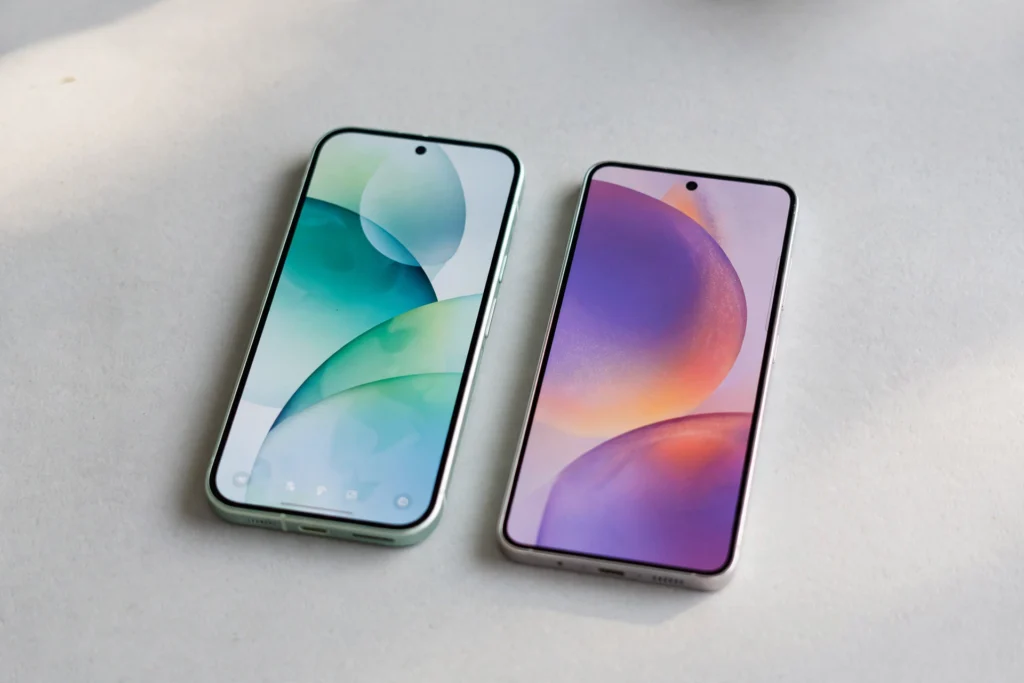
If physical compactness and featherweight portability are your non-negotiable benchmarks, the Samsung Galaxy S24 is an astonishing engineering achievement. Measuring 147.0 x 70.6 x 7.6 mm and weighing an ethereal 167 grams, the S24 is one of the lightest, slimmest premium smartphones on the market. Its flat armor-aluminum side rails feature a silky satin texture with gently rounded corners that nestle into your palm with zero hand fatigue. Its front display bezels are razor-thin and mathematically symmetrical, maximizing screen real estate within an ultra-compact footprint. It features IP68 water and dust submersion resistance and flat Gorilla Glass Victus 2 front and back.
Pixel 9: Substantial Luxury and Industrial Authority
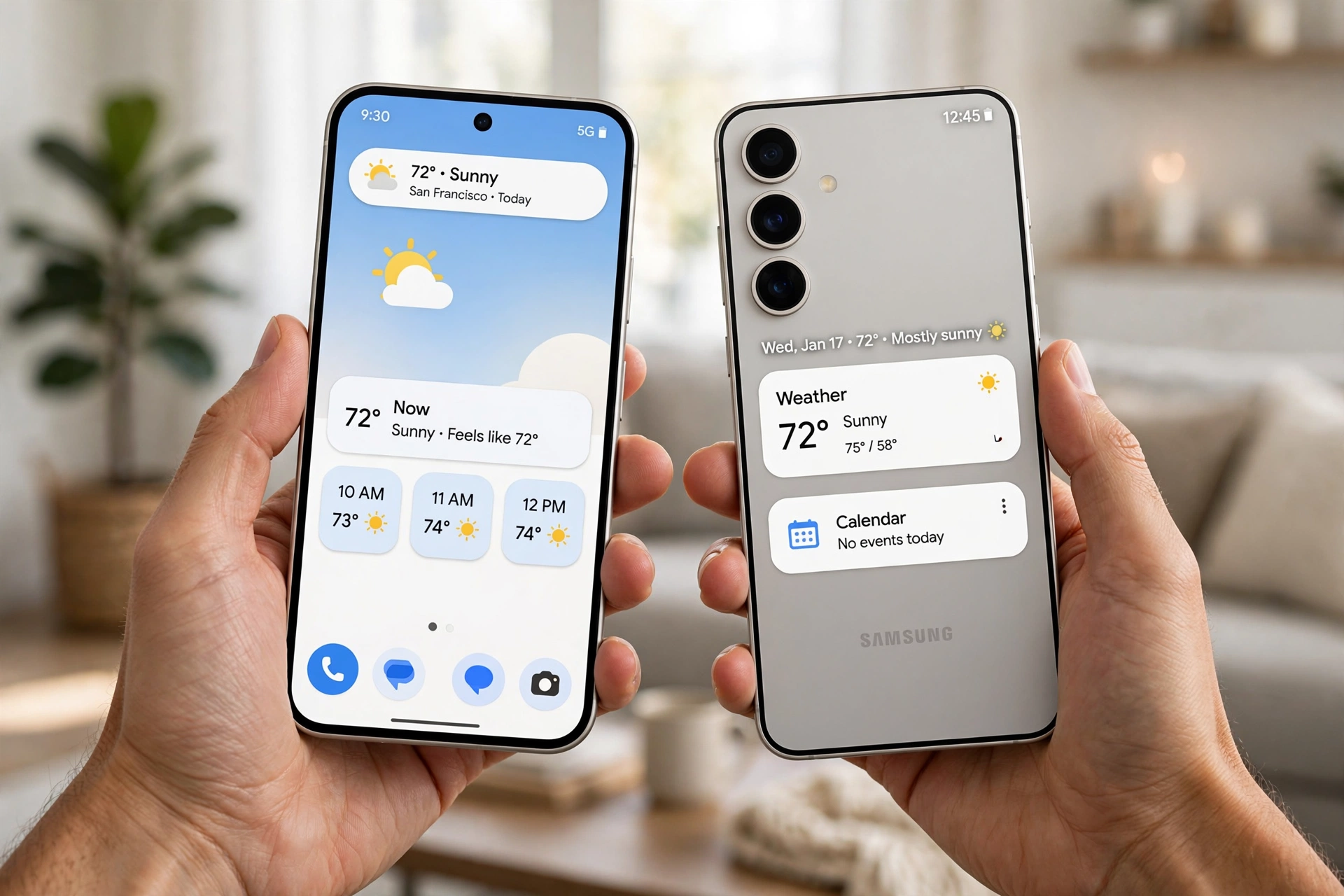
With the Pixel 9, Google overhauled its industrial design, adopting flat satin metal side rails and a glossy glass rear back. Measuring 152.8 x 72.0 x 8.5 mm and weighing 198 grams, the Pixel 9 is noticeably taller, thicker, and roughly 31 grams heavier than the Samsung. In the hand, the Pixel feels dense, solid, and luxurious—resembling the premium heft of an iPhone 16 Pro.
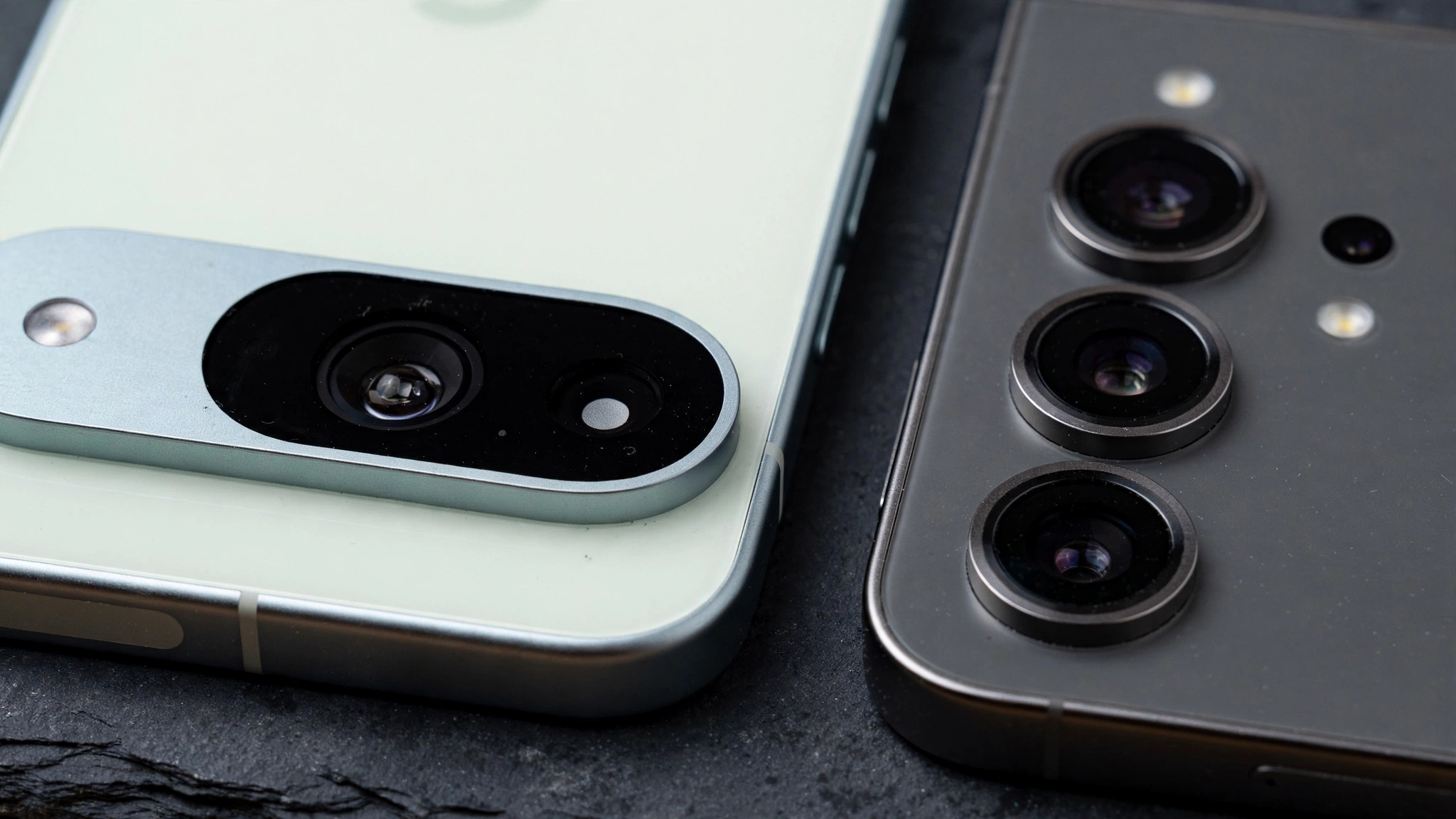
The iconic horizontal camera visor has evolved into a prominent sculpted pill-shaped island. Beyond bold visual branding, this horizontal bar provides a major ergonomic advantage: when resting on a flat desk or tabletop, the Pixel sits with complete stability, whereas the Galaxy wobbles awkwardly when you tap the screen due to its corner-mounted camera lenses. The Pixel 9 also matches Samsung with a certified IP68 water and dust rating.
Display Technology: Compact Visual Brilliance
Both devices feature gorgeous OLED displays that make compact media consumption a visual treat.
Display Specification Comparison
Display Feature | Google Pixel 9 | Samsung Galaxy S24 |
Screen Size & Type | 6.3" Actua OLED | 6.2" Dynamic AMOLED 2X |
Resolution & Density | 2424 x 1080 pixels (422 ppi) | 2340 x 1080 pixels (416 ppi) |
Refresh Rate Range | 60Hz to 120Hz | Dynamic 1Hz to 120Hz (LTPO) |
Peak HDR Brightness | 2,700 nits (1,800 nits HBM) | 2,600 nits (1,500 nits HBM) |
Glass Protection | Corning Gorilla Glass Victus 2 | Corning Gorilla Glass Victus 2 |
Real-World Display Performance
- Outdoor Brightness: In direct outdoor sunlight, both displays perform brilliantly. The Pixel 9 holds a slight edge in High Brightness Mode (HBM), achieving 1,800 nits across the entire display, making map navigation under harsh midday sun effortless.
- LTPO Variable Refresh Rate: Here, Samsung holds a significant technological advantage. The Galaxy S24 utilizes an advanced LTPO backplane that scales smoothly from 120Hz down to 1Hz when viewing static text or images, conserving precious battery power. The base Pixel 9 utilizes a standard LTPS display that toggles only between 60Hz and 120Hz, lacking the sub-10Hz power savings of the Galaxy.
Silicon Performance and Thermals: Tensor G4 vs Snapdragon 8 Gen 3
In this Google vs Samsung base phone clash, the processors reflect completely different corporate priorities.
Qualcomm Snapdragon 8 Gen 3 (Galaxy S24)
In the North American market, the Galaxy S24 is powered by the flagship Snapdragon 8 Gen 3 for Galaxy (with European and global models featuring Samsung's Exynos 2400). In raw synthetic benchmarks and heavy 3D gaming, the Snapdragon platform dominates. In demanding titles like Genshin Impact or high-framerate competitive shooters, the Galaxy delivers higher average frame rates. One notable bottleneck: the base Galaxy S24 ships with 8GB of RAM standard.
Google Tensor G4 (Pixel 9)
The Pixel 9 is powered by Google's custom Tensor G4 processor. While synthetic benchmark scores trail the Snapdragon, Google addressed the biggest flaw of previous generations by equipping the base Pixel 9 with a generous 12GB of LPDDR5X RAM as standard. This massive memory boost ensures that on-device AI models (Gemini Nano) run smoothly in the background while keeping dozens of apps open in RAM without aggressive app-killing. In everyday daily use—navigating apps, browsing feeds, editing photos—the Pixel 9 feels effortlessly fast and fluid.
Camera Systems: Computational Photography vs Optical Versatility
For mobile photography enthusiasts, camera performance is often the deciding factor in a compact flagship.
Camera Hardware Specifications
Camera Module | Google Pixel 9 | Samsung Galaxy S24 |
Primary Wide | 50 MP, f/1.68, 1/1.31" sensor, OIS | 50 MP, f/1.8, 1/1.56" sensor, OIS |
Ultra-Wide | 48 MP, f/1.7, 123° FOV, Macro Focus | 12 MP, f/2.2, 120° FOV |
Telephoto Zoom | None (Uses 2x In-Sensor Crop) | 10 MP, f/2.4, 3x Optical Zoom, OIS |
Front Selfie | 10.5 MP, f/2.2, Autofocus | 12 MP, f/2.2, Dual Pixel AF |
Real-World Photographic Dynamics
- Main Camera & Candid Motion: The Pixel 9's larger 1/1.31-inch primary sensor captures more physical light than Samsung's smaller sensor. Combined with Google's Zero Shutter Lag and Real Tone algorithms, the Pixel captures sharp, candid photos of active children and pets with natural skin tones where Samsung often introduces slight motion blur.
- Ultra-Wide & Macro: The Pixel 9 upgrades to a massive 48MP ultra-wide sensor with Macro Focus, capturing stunning close-up textures and rich low-light landscapes. Samsung's 12MP ultra-wide lacks macro autofocus.
- Optical Telephoto Zoom: Here, the Galaxy S24 fights back with hardware versatility. Samsung includes a dedicated 3x optical telephoto lens. At 3x to 10x magnification, the Galaxy captures crisper architectural details and flattering portraits, whereas the Pixel relies on a 2x sensor crop and computational Super Res Zoom.
Battery Life and Charging Speed: Capacity vs Efficiency
Powering a compact flagship through a grueling 16-hour workday requires smart power management.
Endurance Comparison
- Google Pixel 9: Packs a massive 4,700 mAh battery—an extraordinary capacity for a 6.3-inch phone. Combined with the efficient Tensor G4 and Samsung-built OLED panel, the Pixel 9 is an endurance champion, delivering 7.5 to 8.5 hours of screen-on time, easily providing 1.5 days of moderate use.
- Samsung Galaxy S24: Houses a smaller 4,000 mAh battery. Thanks to its LTPO 1–120Hz display and efficient Snapdragon chipset, the S24 delivers a solid full day of battery life (6 to 7 hours screen time). However, in prolonged 5G data sessions, the Pixel's larger battery gives it a distinct 15% to 20% endurance advantage.
Wired and Wireless Charging
Both devices charge at modest speeds: the Pixel 9 supports 27W wired charging (reaching 55% in 30 minutes), while the Galaxy S24 supports 25W wired charging (reaching 50% in 30 minutes). Both support standard 15W wireless charging and reverse wireless power sharing.
Software Experience and AI Capabilities
Both smartphones guarantee 7 full years of Android OS upgrades and security patches, ensuring both devices remain supported through 2031.
Google Pixel Experience: Clean and Helpful
The Pixel 9 runs pure Android 15 with zero bloatware or duplicate app stores. Key AI highlights include:
- Pixel Screenshots: An on-device AI search engine that indexes all your screenshots using conversational natural language.
- Call Screen: Industry-leading automated robocall filtering.
- Gemini Live: Conversational voice assistant for complex brainstorming and summarization.
Samsung One UI: Feature-Dense Customization
Samsung's One UI 6.1+ caters to power users who want deep customizability:
- Samsung DeX: Transforms your phone into a full desktop computer when plugged into an external monitor.
- Galaxy AI: Live call translation, Note Assist auto-formatting, and Circle to Search.
- Good Lock Customization: Total control over gestures, notification layouts, and volume panels.
Feature Comparison & Decision Matrix
Category | Google Pixel 9 | Samsung Galaxy S24 | Advantage |
Weight & Ergonomics | 198g (Dense / Solid) | 167g (Featherweight) | Galaxy S24 (Lighter / Smaller) |
Standard RAM | 12 GB LPDDR5X | 8 GB LPDDR5X | Pixel 9 (+50% More RAM) |
Display Technology | 60–120Hz LTPS | 1–120Hz LTPO Dynamic | Galaxy S24 (True LTPO) |
Battery Capacity | 4,700 mAh | 4,000 mAh | Pixel 9 (+700 mAh More) |
Main Camera Sensor | 50 MP (1/1.31" Large) | 50 MP (1/1.56" Standard) | Pixel 9 (Better Low-Light) |
Dedicated Telephoto | No (2x Sensor Crop) | Yes (3x Optical Zoom) | Galaxy S24 |
Gaming Performance | Tensor G4 | Snapdragon 8 Gen 3 | Galaxy S24 |
Desktop PC Mode | No | Yes (Samsung DeX) | Galaxy S24 |
Software Longevity | 7 Full Years | 7 Full Years | Tie (Both Through 2031) |
Frequently Asked Questions (FAQ)
Which phone is genuinely easier to use with one hand?
The Samsung Galaxy S24 is noticeably easier to use with one hand. At just 167 grams and 7.6 mm thin with narrower 70.6 mm width, it requires significantly less thumb gymnastics to reach across the keyboard and top notification shade than the heavier, wider Pixel 9.
Does having 12GB of RAM on the Pixel 9 make a real-world difference?
Yes. As modern Android features on-device generative AI models (like Gemini Nano) running in background memory, having 12GB of RAM ensures that your active apps, browser tabs, and navigation routes remain cached in memory without being forced closed, providing superior multitasking retention compared to Samsung's 8GB.
Can the Pixel 9 take good zoom photos without a dedicated telephoto lens?
Up to 2x or 3x magnification, the Pixel 9's 50MP sensor crop and Super Res Zoom algorithms produce sharp, clean images suitable for social media. However, beyond 3x magnification, the Galaxy S24's dedicated 3x optical glass produces visibly superior fine texture definition and clarity.
Do both phones support wireless charging and reverse wireless sharing?
Yes, both devices support standard 15W Qi wireless charging and reverse wireless power sharing (Battery Share on Pixel, Wireless PowerShare on Samsung) to top up wireless earbuds or smartwatches from the back of the phone.
Which phone has a better fingerprint scanner?
The Galaxy S24 uses Qualcomm's 3D Sonic Ultrasonic fingerprint sensor, which unlocks in milliseconds even when fingers are slightly damp. The Pixel 9 also upgraded to an ultrasonic fingerprint sensor, eliminating the slower optical sensors of previous Pixel generations and matching Samsung's speed.
Which phone has better speakers?
Both feature stereo speaker setups. The Pixel 9's slightly thicker chassis provides greater internal acoustic resonance, delivering warmer low-end bass response, while the Galaxy S24 produces slightly brighter vocal clarity.

Conclusion: The Definitive Compact Android Verdict
The compact Android flagship landscape in 2026 is stronger than ever. Both the Pixel 9 and Galaxy S24 deliver elite performance, gorgeous displays, and reassuring 7-year longevity in pocketable footprints.
Buy the Google Pixel 9 if:
- You prioritize camera quality for candid portraits, pets, and low-light photography.
- You want multi-day battery endurance powered by a massive 4,700mAh battery.
- You want future-proof multitasking with 12GB of standard RAM.
- You appreciate clean, bloatware-free software with Day-One Android updates.
Buy the Samsung Galaxy S24 if:
- You demand the lightest, slimmest, and most comfortable one-handed ergonomics (167g).
- You want optical zoom versatility with a dedicated 3x telephoto camera.
- You play demanding 3D games and want the raw compute horsepower of Snapdragon 8 Gen 3.
- You utilize Samsung DeX to transform your phone into a desktop PC.
Choose the companion that best matches your lifestyle and enjoy the unmatched comfort of a true compact flagship powerhouse.