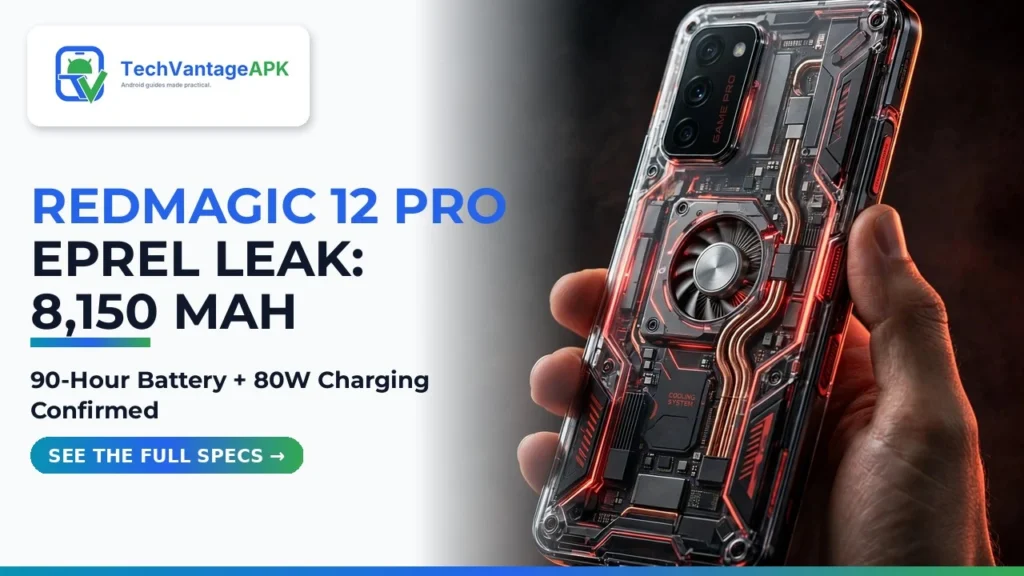
The RedMagic 12 Pro is officially on its way to global markets, and this time the details come from an unusually reliable source: a European regulatory filing. Ahead of its confirmed November 3, 2026 global launch, the gaming phone — model number NX819J — has appeared in the European Product Registry for Energy Labelling (EPREL), revealing its battery capacity, charging requirements, durability ratings, and energy-efficiency class. For buyers weighing a gaming flagship, these are exactly the numbers that matter most, and they paint a clear picture of a phone built to last through long sessions.
What the EPREL Listing Reveals
EPREL is the European Union’s mandatory registry for energy labelling. Manufacturers selling electronics in the EU must file standardized data on battery endurance, cycle life, and charger requirements, which means the figures in the listing are measured under consistent rules rather than marketing conditions. That makes the RedMagic 12 Pro entry especially useful: it lets buyers compare this phone against rivals on a like-for-like basis.
According to the listing, first spotted by The Tech Outlook and corroborated by multiple outlets on October 24–25, 2026, the RedMagic 12 Pro carries a rated battery capacity of 8,150 mAh, an energy-efficiency class of A, battery endurance of 90 hours and 14 minutes per cycle, and a charging durability rating of 1,000 cycles. It requires a USB Type-C charger with an 80W output, carries an IP68 dust and water resistance rating, and has screen scratch resistance rated at Level 4 on the Mohs hardness scale. The listing also notes a minimum software support period of five years from the date the model is withdrawn from the market.
| EPREL item | RedMagic 12 Pro (NX819J) |
|---|---|
| Rated battery capacity | 8,150 mAh |
| Typical battery capacity (brand figure) | 8,400 mAh |
| Energy-efficiency class | Class A |
| Battery endurance per cycle | 90 hours 14 minutes |
| Battery durability | 1,000 charging cycles |
| Charger requirement | USB Type-C, 80W output |
| Dust and water resistance | IP68 |
| Screen scratch resistance | Level 4 (Mohs scale) |
| Minimum support period | 5 years after market withdrawal |
| Global launch | November 3, 2026 |
Rated vs. Typical Battery: Why Two Numbers?
If you have followed the RedMagic 12 Pro’s China launch, you may have seen an 8,400 mAh figure quoted everywhere. Both numbers are correct — they just measure different things. The 8,400 mAh figure is the typical capacity: the average capacity of the battery cells as designed. The 8,150 mAh figure in the EPREL listing is the rated (minimum guaranteed) capacity under European testing protocols. Regulators require the conservative number so consumers are never promised more than the weakest acceptable cell delivers.
This distinction matters beyond one phone. When brands advertise battery sizes, they almost always quote the typical figure, which can run a few percent above the rated minimum. EPREL strips that marketing layer away. For the RedMagic 12 Pro, the gap between rated and typical capacity is only about 3 percent — small by industry standards — which suggests the silicon-carbon cell inside is consistent and well-binned.
Battery Endurance: 90 Hours Per Cycle
The headline endurance figure — 90 hours and 14 minutes per cycle — deserves some unpacking. EPREL’s endurance test is not a gaming marathon; it is a standardized cycle of mixed usage that approximates real-world, day-to-day use, including standby time. A phone that scores 90 hours on this test is not promising four days of heavy gaming. What it does promise is that a moderate user can comfortably stretch to two days between charges, and that even a heavy gamer will end most days with charge to spare.
That endurance comes from the sheer size of the cell. At 8,400 mAh typical, the RedMagic 12 Pro’s battery is roughly 60 percent larger than the 5,000–5,400 mAh cells found in most mainstream flagships. Silicon-carbon anode chemistry is what makes that possible without turning the phone into a brick: the China model packs the cell into an 8.55 mm chassis weighing 223 grams, dimensions that would have been unthinkable for an 8,400 mAh phone a few years ago.
1,000 Charging Cycles: What Durability Means
The 1,000-cycle durability rating is equally important for a gaming phone. One cycle is a full 0–100 percent charge equivalent, and the rating indicates how many cycles the battery can survive before its capacity degrades below the EU’s threshold (typically 80 percent of original capacity). For a user who charges daily, 1,000 cycles translates to roughly three years of use before noticeable degradation — a reassuring figure for a device bought for long-term gaming.
Gaming phones historically suffered faster battery wear because sustained high loads generate heat, and heat accelerates chemical aging. RedMagic’s answer in the China-market Pro+ model is a direct bypass charging mode that routes power straight to the motherboard during play, bypassing the battery entirely. While the EPREL entry does not confirm every feature of the global model, the 1,000-cycle rating suggests the global variant inherits serious battery-health engineering.
Charging: 80W for the Global Model
The EPREL listing specifies an 80W USB Type-C charger requirement for the global RedMagic 12 Pro. That is a notable difference from the China-market RedMagic 12 Pro+, which supports 120W wired charging (a full charge in under 35 minutes, according to the brand) plus 80W wireless charging and 22.5W reverse wired charging. Global models of RedMagic phones have historically shipped with reduced wired charging speeds compared with their China counterparts, and the EPREL entry confirms that pattern continues.
Should buyers be disappointed? In practice, 80W still fills an 8,400 mAh battery far faster than the 25–45W charging common on mainstream flagships. The more relevant comparison is charging time, not wattage: even at 80W, a phone this large should reach a full charge in roughly an hour. The open question is whether the global model keeps the 80W wireless charging of the China Pro+ — the EPREL entry specifies the wired charger requirement only, so wireless details will have to wait for the November 3 announcement.
RedMagic 12 Pro vs. the China Pro+ Model
| Feature | Global RedMagic 12 Pro (EPREL) | China RedMagic 12 Pro+ |
|---|---|---|
| Battery (typical) | 8,400 mAh | 8,400 mAh |
| Battery (rated) | 8,150 mAh | Not disclosed in EPREL |
| Wired charging | 80W (per EPREL charger requirement) | 120W |
| Wireless charging | To be confirmed | 80W |
| Energy class / endurance | Class A, 90h 14m per cycle | Not filed in EPREL |
| Durability | 1,000 cycles, IP68 | IP68/IP69 (brand claim) |
| Display | To be confirmed | 6.85-inch BOE OLED, 185Hz, 5,000 nits peak |
| Processor | To be confirmed | Snapdragon 8 Elite Extreme Gen 6 + RedCore R5 |
| Cameras | To be confirmed | 50MP main (OIS) + 50MP ultrawide, 16MP under-display selfie |
| Software | 5-year minimum support (EPREL) | Android 17, RedMagic OS 12 |
The table makes the strategy clear: the global model keeps the battery, endurance, and durability story intact while trimming peak wired charging speed. For most buyers, that is the right trade — battery size and longevity affect every day of ownership, while the difference between 80W and 120W charging saves minutes, not hours.
The Rest of the Package: What to Expect on November 3
While the EPREL filing covers energy and durability, the China launch fills in the rest of the spec sheet, and global models have historically mirrored it closely. The China RedMagic 12 Pro+ features a 6.85-inch BOE X11 OLED display (2,688 × 2,126 pixels) with a 185Hz refresh rate and 5,000 nits peak brightness, Qualcomm’s Snapdragon 8 Elite Extreme Gen 6 paired with RedCore R5 and G1 chips, up to 24GB of RAM and 1TB of storage, a 50MP main camera with optical image stabilization alongside a 50MP ultrawide, and a 16MP under-display selfie camera. Connectivity includes 5G, Wi-Fi 7, Bluetooth 6.0, NFC, and USB-C 3.2 Gen 2, plus stereo speakers with Dolby Atmos and a 3.5mm headphone jack — a rarity that remains a genuine selling point for gamers.
One spec worth watching is the refresh rate debate. Some early community reaction has questioned whether 185Hz is meaningful when most games cap at 120–144Hz. The honest answer: the benefit shows up in system animations, scrolling, and the small number of titles that do support higher rates — but the display’s brightness and color performance will matter more to most players than the last 40Hz.
Pricing: What the China Launch Suggests
The China-market RedMagic 12 Pro+ launched at 6,999 yuan (about $1,046) for 12GB + 256GB, 7,999 yuan (about $1,195) for 16GB + 512GB, and 8,999 yuan (about $1,345) for 16GB + 1TB, with the top 24GB + 1TB configuration’s price unannounced at launch. Global pricing has historically landed higher after taxes and distribution costs, and the base global model (without the “+” extras) may sit below the China Pro+ tier. Expect firm global prices at the November 3 event — and watch for early-bird bundles, which RedMagic frequently uses to soften launch pricing.
Should You Wait for the RedMagic 12 Pro?
Buy it if you are a heavy mobile gamer who hates battery anxiety, if you keep phones for three or more years (the 1,000-cycle rating and five-year support window are built for that), or if you want flagship gaming hardware with a headphone jack and an under-display selfie camera. Wait or look elsewhere if you need the fastest possible charging (the China Pro+ at 120W is not coming globally in this form), if camera quality is your top priority (RedMagic cameras are good, not class-leading), or if you prefer a lighter phone — 223 grams is substantial.
The EPREL filing does one more useful thing: it removes guesswork. Before November 3, buyers already know the battery story in standardized, comparable numbers. In a market where battery claims are routinely inflated, that transparency is itself a reason to take this phone seriously.
Gaming Performance Beyond the Battery
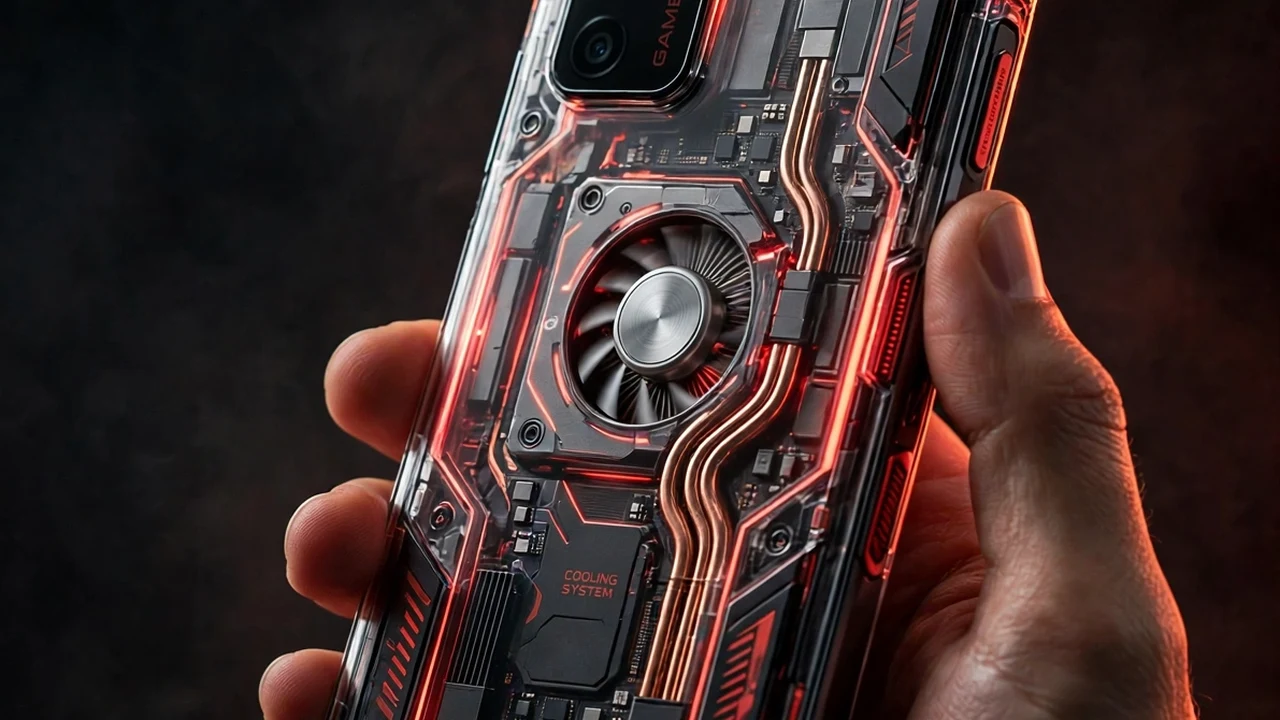
A big battery only matters if the phone can sustain performance while using it, and here the China model’s hardware is encouraging. The Snapdragon 8 Elite Extreme Gen 6, paired with RedMagic’s own RedCore R5 and G1 auxiliary chips, is built for exactly this workload: the main chip handles game rendering while the auxiliary silicon manages touch sampling, display refresh, and thermal distribution. RedMagic’s signature internal cooling fan — a feature no mainstream flagship offers — pushes air through the chassis during sustained play, which is why the phone can hold high frame rates without the aggressive thermal throttling that turns many thin flagships into stuttering handsets after twenty minutes of play.
The 185Hz display deserves a balanced assessment. On paper it is the fastest refresh rate in a mainstream gaming phone, and system animations and scrolling genuinely look smoother at 185Hz than at 120Hz. In games, the benefit is narrower: most mobile titles cap frame rates at 120Hz or 144Hz, and only a handful of competitive titles support higher rates. Buyers should therefore treat 185Hz as a bonus, not a buying reason, and weigh the display’s 5,000-nit peak brightness and BOE X11 panel quality more heavily. For outdoor gaming, that brightness matters far more than refresh rate — a dim screen ruins a match faster than a capped frame rate ever will.
Audio and controls round out the gaming case. Stereo speakers with Dolby Atmos, a 3.5mm headphone jack for zero-latency wired audio, ultrasonic under-display fingerprint sensing, and shoulder triggers on previous RedMagic generations (watch for confirmation on the global model) all target players who take mobile gaming seriously. Add 5G, Wi-Fi 7, and Bluetooth 6.0, and the connectivity story is complete for competitive play.
Software Support: Five Years, Explained Carefully
The EPREL entry’s five-year minimum support period is easy to misread. It does not promise five years of Android version upgrades. Under EU rules, it means spare parts, security updates, and software support availability for at least five years after the model is withdrawn from the market — a consumer-protection floor, not a version-upgrade roadmap. The practical implication is still positive: RedMagic cannot abandon the device quickly, and security patches should continue well into the phone’s usable life.
For buyers, the right question at the November 3 event is how many Android OS upgrades the global model will receive, and whether RedMagic OS 12’s gaming features — such as the Game Space dashboard, performance profiles, and bypass charging controls — carry over in full. Gaming phones live or die on software maintenance: a phone that stops receiving game-compatibility updates becomes a worse gaming device over time even if its hardware is unchanged. RedMagic’s recent track record has improved on this front, but the global model’s update policy deserves a direct answer before purchase.
RedMagic 12 Pro vs. Mainstream Flagships
| RedMagic 12 Pro (global) | Typical mainstream flagship | |
|---|---|---|
| Battery | 8,400 mAh typical | 5,000–5,400 mAh |
| Wired charging | 80W | 25–45W |
| Cooling | Internal active fan (China model) | Passive vapor chamber only |
| Refresh rate | 185Hz (China model) | 120Hz |
| Headphone jack | Yes (China model) | Almost never |
| Selfie camera | Under-display 16MP (China model) | Punch-hole |
| Water resistance | IP68 | IP68 |
| Camera priority | Good, not class-leading | Often the top priority |
The trade is honest and consistent: RedMagic gives you battery, cooling, and gaming-first hardware, and asks you to accept a camera system that is competent rather than chart-topping. For a second phone or a gaming-first buyer, that is an easy trade. As a sole phone for someone who photographs constantly, it is worth weighing carefully.
Frequently Asked Questions
When does the RedMagic 12 Pro launch globally?
The global launch is scheduled for November 3, 2026, at 7:00 AM EST, according to RedMagic’s launch page as cited by The Tech Outlook. Full global specifications, pricing, and availability are expected at that event.
What is the RedMagic 12 Pro’s battery capacity?
The EPREL listing gives a rated capacity of 8,150 mAh, while RedMagic advertises a typical capacity of 8,400 mAh. The rated figure is the minimum guaranteed capacity under EU testing; the typical figure is the average cell capacity.
How fast does the global RedMagic 12 Pro charge?
The EPREL entry specifies an 80W USB Type-C charger requirement for the global model. That is slower than the China Pro+ model’s 120W wired charging, but still far faster than most mainstream flagships.
How long will the battery last?
EPREL rates endurance at 90 hours and 14 minutes per standardized cycle, with durability of 1,000 charging cycles. In practice, expect comfortable two-day use for moderate users and a full day of heavy gaming.
Is the RedMagic 12 Pro water resistant?
Yes. The EPREL listing records an IP68 dust and water resistance rating, and the screen carries a Level 4 Mohs hardness scratch-resistance rating.