
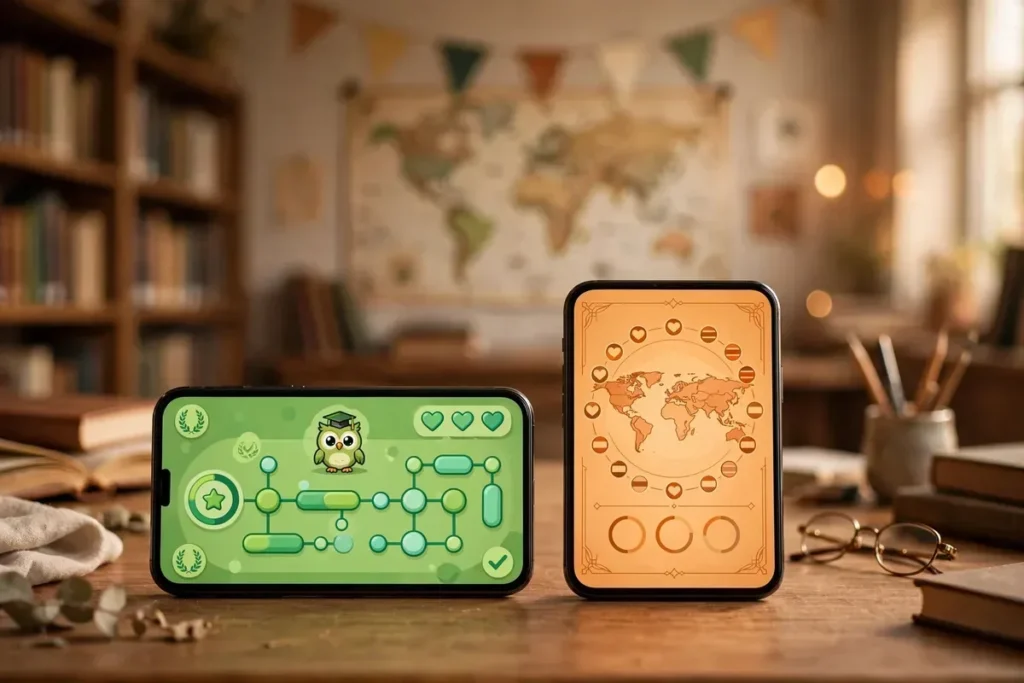
Duolingo vs Babbel: Which Language App Works in 2026?
Learning a language on your phone is mainstream now, and the Duolingo vs Babbel choice shapes how — and whether — you succeed. Duolingo is the gamified giant: free, fun, and famous for its owl mascot and streak obsession. Babbel is the structured course: paid, serious, built around real conversations by language experts. One feels like a game, the other like a class. This Duolingo vs Babbel comparison examines teaching methods, effectiveness, pricing, languages offered, and motivation to answer which language app actually works in 2026.
Language App FAQ
How long until conversational? With 20 minutes daily plus real conversation practice from month 3, basic conversation in 6-9 months for easy languages (Spanish, French), 12-18 for hard ones (Mandarin, Arabic).
Free Duolingo vs paid Babbel? Duolingo’s free tier suffices for habit-building; Babbel’s subscription ($7-14/month) buys structured grammar. Many learners use Duolingo free for streaks plus Babbel for depth.
Can apps replace a tutor? No — apps build vocabulary and pattern recognition; conversation requires a human. Budget for tutors from month 3-4 onward.
What Actually Builds Language Skill (Beyond the App)
Apps teach vocabulary and grammar patterns; they do not teach conversation. The research consensus (from studies on second-language acquisition) is that comprehensible input — reading and listening to material slightly above your level — drives most progress, with apps serving as the on-ramp. Practical progression: app drills for months 1-3, graded readers and slow podcasts for months 3-6, then real conversation via tutors (iTalki sessions run $8 to $15/hour) or language exchanges from month 4 onward.
Between Duolingo and Babbel specifically: Duolingo’s free tier and game loop build stronger daily habits; Babbel’s structured lessons teach grammar more explicitly and its speech recognition gives better pronunciation feedback. Neither alone produces conversational ability — plan from the start to graduate beyond the app. The learners who succeed treat the app as 30 percent of the method, not 100 percent.
Duolingo vs Babbel: Teaching Methods Compared

Duolingo’s method is gamified immersion: bite-sized lessons with translation, matching, listening, and speaking exercises, wrapped in XP points, leagues, streaks, and hearts. You learn by doing — lots of repetition, spaced naturally. It is genuinely fun, which is why hundreds of millions have tried it. The curriculum progresses from basics toward intermediate content, with stories and podcasts for some languages.
Babbel’s method is structured conversation: lessons designed by linguists around real-life dialogues (ordering food, small talk, business meetings), with explicit grammar explanations Duolingo often skips. Each 10-15 minute lesson builds toward speaking confidently in specific situations. Review sessions use spaced repetition scientifically, and speech recognition gives pronunciation feedback.
The pedagogical difference: Duolingo teaches you to recognize and play with language; Babbel teaches you to hold conversations. Studies on app-based learning suggest structured conversation practice (Babbel’s approach) produces better speaking outcomes, while gamified repetition (Duolingo) excels at vocabulary building and habit formation. Your goal decides: tourists and conversationalists lean Babbel; casual learners and habit-builders lean Duolingo.
Effectiveness: Which Actually Teaches You?
The uncomfortable question: do these apps work? Research and user outcomes say: partially, with caveats. Duolingo’s own studies show dedicated users reach roughly A2-B1 (elementary to intermediate) proficiency after sustained use — enough for basic conversations, not fluency. Its weakness is speaking: you can ace lessons yet freeze in real conversation because the app rarely demands spontaneous speech.
Babbel commissioned studies showing beginners reaching conversational ability in the target language’s basics after ~15 hours — plausible for its focused curriculum. Its conversation-first design produces more confident speakers faster, though advanced learners outgrow it sooner (it tops out around B2 intermediate).
Neither app alone creates fluency — that requires immersion, conversation practice, and media consumption. But as foundations, both work: Duolingo builds vocabulary and habit; Babbel builds conversational competence. Serious learners should pair either with conversation practice (tutors, language exchanges) for real results. In the Duolingo vs Babbel effectiveness debate, Babbel edges ahead for speaking outcomes, Duolingo for sustained engagement.
Pricing: Free vs Paid

Duolingo’s free tier is fully functional: complete courses, all languages, unlimited learning with ads and a hearts system (mistakes cost hearts that refill over time). Super Duolingo ($6.99/month or $83.99/year) removes ads and hearts, adds offline lessons, and unlocks extras. Duolingo Max ($29.99/month) adds AI conversation practice and video calls with the owl.
Babbel has no free tier beyond trial lessons — subscriptions run $14.95/month monthly, dropping to ~$7/month on longer plans, with lifetime deals ($299-399) appearing during sales. Babbel for Teams covers corporate learning.
Value depends on commitment: dabblers should use Duolingo free; serious learners get more per dollar from Babbel’s structured courses than from Duolingo’s subscriptions. A year of Babbel (~$84 on annual plan) versus Super Duolingo ($84/year) is the fair comparison — and for dedicated study, Babbel’s curriculum justifies its price. Budget learners can also explore free alternatives, but the Duolingo vs Babbel paid comparison favors Babbel for serious study.
Languages Offered
Duolingo offers 40+ languages including less-common ones (Welsh, Navajo, Hawaiian, Klingon, High Valyrian) — unmatched breadth, though course depth varies wildly. Popular languages (Spanish, French, German) have rich content with stories and podcasts; smaller courses can feel thin.
Babbel offers 14 languages, all with full professional curricula: Spanish, French, German, Italian, Portuguese, Dutch, Swedish, Norwegian, Danish, Polish, Turkish, Indonesian, Russian, and English (for non-English speakers). Every course is deep and consistent — no thin offerings.
If you are learning Spanish or French, both serve you well. For less-common languages, Duolingo may be your only app option. For depth in major languages, Babbel’s focused catalog wins on quality per language.
Duolingo vs Babbel: Head-to-Head Scorecard
| Category | Duolingo | Babbel | Winner |
|---|---|---|---|
| Price (entry) | Free tier excellent | Paid only (~$7-15/mo) | Duolingo |
| Teaching method | Gamified immersion | Structured conversation | Tie (different goals) |
| Speaking outcomes | Weaker | Stronger | Babbel |
| Vocabulary building | Excellent | Good | Duolingo |
| Grammar explanations | Minimal | Explicit, clear | Babbel |
| Languages offered | 40+ (varying depth) | 14 (all deep) | Duolingo (breadth), Babbel (depth) |
| Motivation/gamification | Best in class | Modest | Duolingo |
| Speech recognition | Basic | Better feedback | Babbel |
| Offline lessons | Paid tiers | Yes | Babbel |
| Advanced content | Up to B1/B2 | Up to B2 | Tie |
Motivation and Habit Formation
Duolingo is a masterclass in behavioral design: streaks, leagues, XP, daily quests, and push notifications from a passive-aggressive owl. Love it or hate it, it works — Duolingo users maintain longer learning streaks than any competitor. The social pressure of leagues and friend quests keeps people returning daily.
Babbel’s motivation is intrinsic: you feel yourself improving at real conversations, which is deeply satisfying. But without gamification, it demands more self-discipline — completion rates lag Duolingo’s. Babbel has added streaks and review reminders, but it will never match Duolingo’s dopamine engineering.
Be honest about yourself: if you need external motivation, Duolingo’s gamification is a feature, not a gimmick. If you are self-driven and find gamification childish, Babbel’s seriousness respects your time. The best method is the one you sustain — a year of Duolingo beats a month of Babbel abandoned.
Speech Practice and Pronunciation
Speaking is where apps historically fail, and both are improving. Duolingo’s speaking exercises ask you to repeat phrases with basic recognition — forgiving, sometimes too forgiving (it accepts rough approximations). Duolingo Max’s AI conversation practice is a genuine step forward, offering open-ended dialogue with feedback.
Babbel’s speech recognition is stricter and more useful, with pronunciation scoring that actually pushes improvement. Its dialogue-based lessons mean you practice speaking in context from lesson one. Neither replaces human conversation — for that, add a tutor (iTalki, Preply) or language exchange (Tandem, HelloTalk) once you have basics. But Babbel gets you conversation-ready faster, which is the point of learning a language. If app notifications interrupt your practice sessions, our notification fixes help.
The Verdict
Choose Duolingo if you want free, fun, habit-forming language exposure: the best gamification in education, 40+ languages, and a free tier that genuinely teaches. It is perfect for beginners, dabblers, and vocabulary building — start at Duolingo.
Choose Babbel if you are serious about conversational ability: structured lessons by linguists, explicit grammar, better speech feedback, and faster path to real conversations. It is worth paying for if you will actually study — details at Babbel.
For most learners, the smart play is Duolingo free for habit-building, then Babbel when you are ready to get serious — or both simultaneously (Duolingo for daily streaks, Babbel for real lessons). In the Duolingo vs Babbel contest, the winner is whichever app keeps you learning past month three.
Learning Multiple Languages at Once
Polyglot ambitions? The Duolingo vs Babbel multi-language experience differs. Duolingo makes juggling easy: switch languages with two taps, maintain separate streaks, and dabble freely — many users casually maintain 2-3 languages. The gamification keeps each streak alive with minimal daily effort. Quality varies by course, but the mechanics are identical. Typing in new scripts is easier with a good multilingual keyboard — see our best Android keyboards picks.
Babbel’s subscription covers all 14 languages, so exploring is affordable — but its serious lesson structure demands more per-language time investment. Juggling two Babbel languages seriously means 30+ minutes daily. The realistic advice: use Duolingo for maintaining secondary languages (10 minutes keeps a streak alive) and Babbel for your primary focus language. This hybrid approach is popular among serious learners and plays to each app’s strength in the Duolingo vs Babbel toolkit.
Kids, Teens, and Family Learning
For young learners, the Duolingo vs Babbel choice is clearer. Duolingo’s gamification was practically designed for kids: colorful, rewarding, and paced for short attention spans. Duolingo ABC serves pre-readers, and the main app engages ages 8+ effectively. Family plans let parents track progress, and classroom tools make it a teacher favorite.
Babbel targets teens and adults — its business dialogues and serious tone bore most kids. For family learning (parents and kids together), Duolingo wins on engagement; supplement with Babbel for teens ready for real conversation skills. Whatever you choose, learning together beats learning alone: family challenges, shared streaks, and practicing phrases at dinner turn an app into an experience. Language learning is one of the few screen-time activities worth encouraging without limits. Document the journey with photos (and know how to recover deleted photos if little fingers delete them).
Beyond the Apps: Completing Your Learning Stack
Here is the truth neither marketing department emphasizes: no app alone makes you fluent. The Duolingo vs Babbel winner still needs supplementation. Once you have basics (2-3 months of consistent app use), add these layers. First, comprehensible input: children’s shows, podcasts for learners, and graded readers in your target language — massive exposure trains your ear in ways drills cannot. Second, conversation: tutors on iTalki or Preply ($5-15/hour) or free exchanges on Tandem give you the spontaneous speaking apps cannot simulate.
Third, media you love: switch your Netflix to the target language with subtitles, follow creators in that language, change your phone’s language for a week. Fourth, spaced-repetition vocabulary (Anki) for words you keep forgetting. The apps are your foundation and daily habit — these layers are the walls and roof. Learners who combine Duolingo or Babbel with even one of these extras progress dramatically faster than app-only users. Fluency is a system, not an app.
FAQ
Is Duolingo free really enough to learn a language?
For basics and vocabulary, yes. For conversational fluency, no app alone suffices — pair it with speaking practice. Duolingo’s free tier is remarkably complete.
Is Babbel worth paying for?
If you study consistently, yes. Its structured conversation-based curriculum produces better speaking outcomes than free alternatives. Casual learners should stick with Duolingo free.
Which app is better for Spanish?
Both are strong for Spanish. Duolingo has more content volume; Babbel has better conversation focus. Try Duolingo free first, then Babbel’s trial.
How long until I can hold a conversation?
With daily Babbel study, basic conversations in 2-3 months is realistic. Duolingo takes longer for speaking confidence. Real fluency needs immersion beyond any app.
Can kids use these apps?
Duolingo ABC and Duolingo’s main app suit kids well (gamified, fun). Babbel targets teens and adults with its serious tone.
Conclusion
The Duolingo vs Babbel answer depends on your commitment. Duolingo wins for accessibility, fun, and habit formation — the free app that gets millions learning daily. Babbel wins for serious conversational results — structured, expert-designed lessons worth paying for. Start free with Duolingo, upgrade to Babbel when you are ready to speak for real, and remember: the best language app is the one you open every day. Your future bilingual self is waiting — and in the Duolingo vs Babbel journey, day one is today.




What do you think?
Share your experience or ask a question. A useful conversation starts with you.
Join the discussion