Mobile strategy gaming is dominated by two massive pillars that have defined the genre for a decade: Clash of Clans (CoC) and Rise of Kingdoms (RoK). While both titles task players with building a civilization from the ground up, the mechanical differences between them are vast. One focuses on precise, asynchronous tactical raids, while the other emphasizes a massive, persistent open-world map with real-time troop movements. To provide a complete picture for strategy enthusiasts, we must also consider Stronghold Kingdoms, a title that brings the intricate PC-style “castle sim” DNA to the mobile platform, serving as a sophisticated alternative for those who find the mainstream hits too streamlined.
Choosing between these titles depends on how much time you can commit and what kind of “general” you want to be. Are you a tactician who enjoys planning a three-minute raid, or a diplomat who thrives in 24-hour alliance warfare? This analysis breaks down the core pillars of these strategy giants to help you decide where to invest your time and resources.
1. Base-Building Depth and Layout Strategy
The foundation of any strategy game is the base. In Clash of Clans, base design is a puzzle. Because your base is subject to asynchronous raids while you are offline, every wall segment and trap placement matters. The grid-based system allows for infinite creativity, forcing players to account for troop AI pathfinding. A well-designed Town Hall 15 base can repel an attacker simply by funneling their troops into high-damage “kill zones.” This makes the building aspect a core part of the competitive meta.
Rise of Kingdoms takes a different approach. Your city is a hub for production, research, and troop training, but its physical layout is largely aesthetic. While you can move buildings around to create a beautiful Roman metropolis or a sprawling Japanese shogunate, the layout does not affect defense in the same way. Defense in RoK is determined by your “City Defense” commander and the sheer number of troops stationed inside. The “building” phase here is more about resource management and tech-tree progression than spatial puzzles.
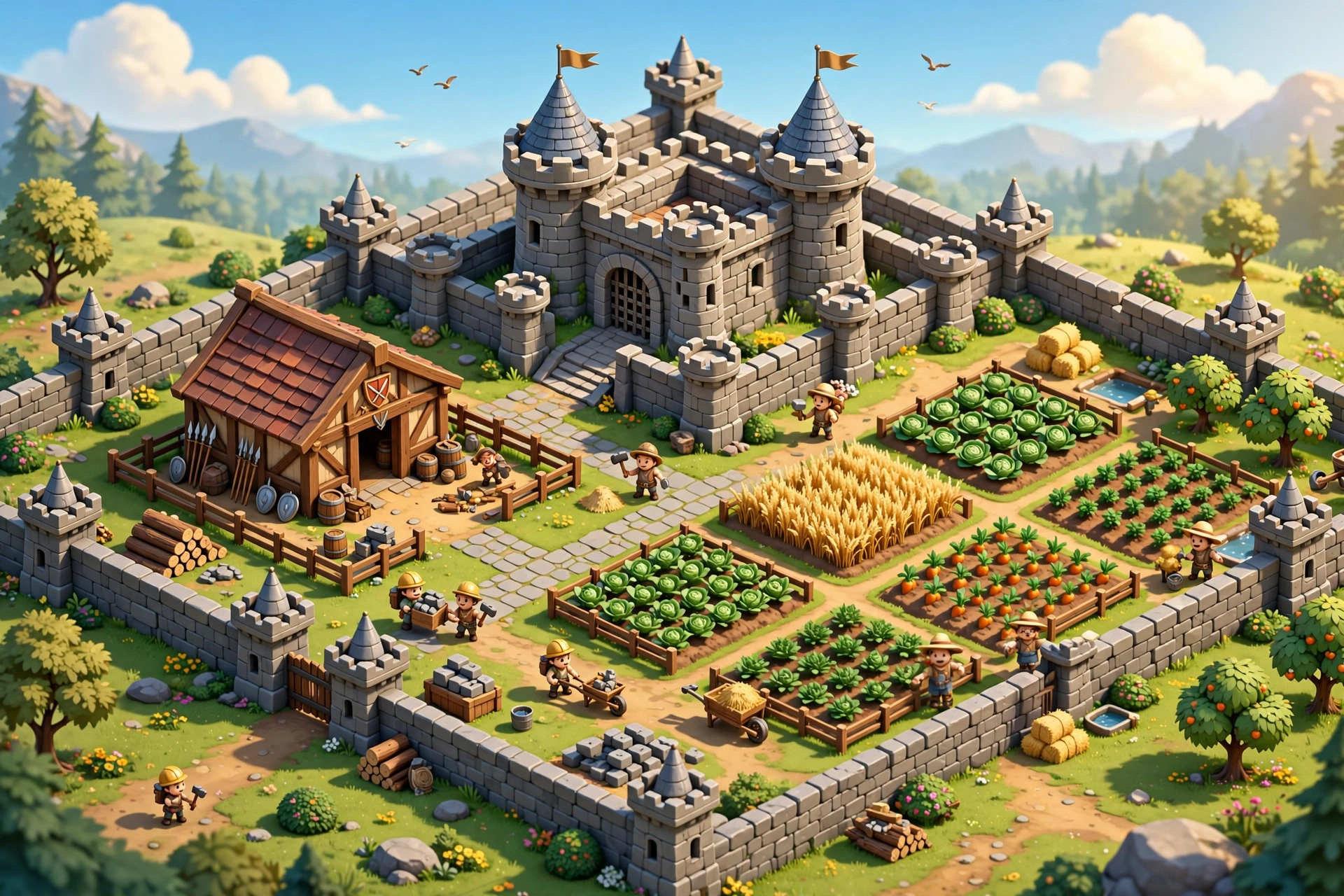
Stronghold Kingdoms offers the most complex building mechanics of the three. Drawing from its PC heritage, it requires players to manage intricate supply chains. You aren’t just placing a barracks; you are managing wood production to build bows, which are then used to equip archers. The castle layout is highly detailed, focusing on structural integrity and the strategic placement of boiling oil and spike pits. For players who want a “city builder” that feels like a simulation, Stronghold Kingdoms is the clear technical winner.
Winner: Clash of Clans (Tactical) / Stronghold Kingdoms (Simulation)
2. Real-Time vs. Asynchronous Combat Mechanics
The most significant divide in the clash of clans vs rise of kingdoms debate is the combat style. Clash of Clans utilizes asynchronous combat. You search for an opponent, analyze their base, and deploy your troops. Once the troops are on the field, you have limited control, though Hero abilities and spells provide crucial mid-battle intervention. This style is perfect for mobile gaming because it allows for short, intense bursts of gameplay that don’t require an active opponent to be online at the same time.
Rise of Kingdoms is built on a “Real-Time Strategy” (RTS) engine. You move your marches freely across a massive, seamless world map. You can intercept an enemy march, retreat to a friendly city, or join a massive “rally” against a neutral fort. This creates a dynamic environment where battles can last for hours and involve hundreds of players simultaneously. The ability to kite enemies or hide in the “fog of war” adds a layer of depth that asynchronous games simply cannot match.
Stronghold Kingdoms sits in the middle, focusing on grand-scale political warfare. Attacks are planned on a world map, and while the battles themselves are simulated based on your castle design and troop composition, the movement of armies across the “Parishes” and “Counties” requires long-term planning and coordination with other “Lords” in your faction.
| Feature | Clash of Clans | Rise of Kingdoms | Stronghold Kingdoms |
|---|---|---|---|
| Combat Style | Asynchronous Raids | Real-Time Open World | Grand Strategy / Sim |
| Unit Control | Deployment-based AI | Full manual movement | Tactical placement |
| Session Length | 3-5 Minutes | 20 Minutes to 2 Hours | Variable (Long-term) |
| Map Scope | Individual Bases | Single Persistent World | Real-world Geography |
Winner: Rise of Kingdoms
3. Alliance Warfare and Social Scale
Social interaction is the glue that holds these games together. In Clash of Clans, the “Clan” experience is centered around Clan Wars and the Clan War Leagues. These are structured, small-scale events where 10 to 50 players coordinate to attack specific targets. It is intimate and requires high individual skill. Communication is vital, but the scale is contained within a private instance.
Rise of Kingdoms operates on a scale that is frankly staggering. Alliances don’t just chat; they control territory. They build flags to expand their borders, fight over resource nodes, and participate in “Kingdom vs. Kingdom” (KvK) events that pit thousands of players from different servers against one another. The diplomacy in RoK is a game in itself, involving NAP (Non-Aggression Pact) agreements, betrayals, and massive coalitions. If you want to feel like a small part of a massive army, RoK provides that experience better than almost any other mobile title.
Stronghold Kingdoms takes the social aspect into the realm of feudal politics. Players can be elected as Sheriffs or Governors, and the hierarchy within a House is rigid. You aren’t just a member of a club; you are a vassal in a kingdom. This appeals to fans of best strategy games for Android who prefer political maneuvering over raw clicking speed. The stakes are high, as losing a war can mean losing a village you’ve spent months cultivating.
Winner: Rise of Kingdoms
4. Progression, Grind, and Monetization Models
All three games are free-to-play with significant monetization, but they handle the “grind” differently. Clash of Clans is famous for its long build times. At higher Town Hall levels, a single building upgrade can take 14 to 20 days. However, Supercell has balanced the game so that “pay-to-win” elements are mostly limited to speeding up time. A low-spending player can still reach the highest competitive levels through persistence and skill. The introduction of the Gold Pass has made the game more accessible to casual spenders.
Rise of Kingdoms has a steeper “pay-to-win” curve. Because the game is real-time and open-world, a “whale” (a high-spending player) can theoretically dominate an entire region by purchasing speed-ups and legendary commander sculptures. While the game provides many ways for F2P players to contribute—such as providing support in rallies or gathering resources—the power gap between a spender and a non-spender is more pronounced in RoK than in CoC.
Stronghold Kingdoms uses a “card” system for boosts. While you can play for free, the strategic advantage provided by certain cards (like instant troop replenishment) is significant. However, because the game is slower-paced and more about long-term positioning, a clever strategist can often outmaneuver a spender who lacks a coherent plan. The progression in Stronghold is less about “power levels” and more about “influence” and “rank.”

Winner: Clash of Clans (For F2P Balance)
5. The Learning Curve and Accessibility
Clash of Clans is the gold standard for accessibility. Its tutorial is concise, and its mechanics are introduced at a pace that never feels overwhelming. You learn how to use Barbarians, then Archers, then Giants. By the time you reach complex strategies like “Queen Walks” or “Lavaloon,” you have spent months mastering the basics. This makes it an excellent choice for younger players or those new to the genre.
Rise of Kingdoms is significantly more complex. Between commander pairings, talent trees, equipment crafting, and the nuances of open-field movement, there is a lot to learn. New players often find themselves “zeroed” (having their entire army destroyed) because they didn’t understand how to use their peace shields or joined the wrong alliance. It requires a commitment to reading guides and watching community content to stay competitive.
Stronghold Kingdoms has the steepest learning curve of all. Its UI is a direct port of a PC interface, which can be clunky on smaller screens. The economy is fragile; one bad harvest or a poorly timed tax hike can cripple your village. It is a game for the “hardcore” crowd who grew up playing titles like Age of Empires or the original Stronghold series. It doesn’t hold your hand, which is exactly why its dedicated fanbase loves it.
Winner: Clash of Clans
6. Graphics, Performance, and Art Style
The visual identity of these games defines their target audience. Clash of Clans uses a vibrant, “cartoony” 3D style that is instantly recognizable. It is optimized to run on almost any device, from budget tablets to the latest flagship phones. The animations are fluid, and the visual feedback during a raid—explosions, crumbling walls, and spell effects—is incredibly satisfying.
Rise of Kingdoms opts for a more “stylized historical” look. The commanders are based on real historical figures like Julius Caesar, Sun Tzu, and Joan of Arc, rendered in a high-quality 3D art style. The performance is impressive considering the game has to render thousands of units on a single map. However, during major KvK battles, even high-end devices can experience lag, necessitating the “simplified graphics” mode which turns troops into colored dots.
Stronghold Kingdoms embraces a retro, 2D isometric aesthetic. It looks like a game from 2005, which is a deliberate choice. It prioritizes information density over visual flair. While it won’t win any awards for graphics, its “classic” look is nostalgic for fans of the medieval strategy sub-genre. It is also very light on battery consumption compared to the heavy 3D rendering of RoK.
| Criteria | Clash of Clans | Rise of Kingdoms | Stronghold Kingdoms |
|---|---|---|---|
| Art Style | Vibrant Cartoon | Stylized Historical | Retro Isometric |
| Device Load | Low | High (during wars) | Very Low |
| Visual Feedback | Excellent | Good | Functional |
| Theme | Fantasy | Global Civilizations | Medieval Europe |
Winner: Clash of Clans (Optimization) / Rise of Kingdoms (Aesthetics)

7. Longevity and Developer Support
Supercell has proven that Clash of Clans is not a fad. With over a decade of updates, the game has evolved from a simple raiding game into a complex ecosystem with the Builder Base, Clan Capital, and seasonal events. The developers are highly responsive to the community and frequently rebalance units to keep the meta fresh. For many, CoC is a “forever game.”
Lilith Games, the developer of Rise of Kingdoms, is equally aggressive with updates. They constantly introduce new civilizations (like the Vikings or Egyptians) and new gameplay modes. However, they also tend to introduce new power-creep mechanics that can frustrate long-term players. Despite this, the community remains one of the most active in mobile gaming, with a massive presence on YouTube and Discord.
Stronghold Kingdoms is maintained by Firefly Studios. While it doesn’t receive the same “blockbuster” updates as the other two, it has a loyal, niche following. The developers focus on “World” resets and seasonal tournaments. It is a stable environment for those who are tired of the constant “meta-shifting” of mainstream mobile titles and want a consistent, slow-burn experience similar to top multiplayer strategy games.
Winner: Clash of Clans
The Final Verdict: Which Strategy King Reigns Supreme?
After analyzing the core mechanics, social structures, and progression paths, it is clear that there is no single “best” game, but rather a best game for specific types of players. The clash of clans vs rise of kingdoms rivalry exists because they serve different psychological needs within the strategy genre.
- The Casual Builder: If you have 15 minutes a day and enjoy the satisfaction of slowly upgrading a base and performing a few perfect raids, Clash of Clans is your home. Its polish and fair F2P mechanics make it the most “stress-free” option.
- The Hardcore Strategist: If you want deep economic simulation, complex supply chains, and a game that rewards spreadsheets and long-term planning, Stronghold Kingdoms is the dark horse you should be playing. It respects your intelligence and offers a depth the others lack.
- The History Buff: If you love the idea of leading Samurai, Vikings, or Romans into battle and want to see historical figures come to life, Rise of Kingdoms offers the best thematic immersion and a sense of “civilization” building.
- The Competitive Alliance Warrior: If you live for the drama of diplomacy, the thrill of 100-player battles, and the feeling of conquering territory on a global map, Rise of Kingdoms is the undisputed champion of scale.
Ultimately, Clash of Clans remains the king of “Tactical Raiding,” while Rise of Kingdoms is the king of “World Warfare.” Stronghold Kingdoms remains the king of “Castle Simulation.” Depending on your available time and your preference for real-time vs. asynchronous action, your choice should be clear.
Frequently Asked Questions
Is Clash of Clans or Rise of Kingdoms more pay-to-win?
While both games offer microtransactions, Rise of Kingdoms is generally considered more “pay-to-win” due to its real-time, open-world nature. In RoK, a high-spending player can directly attack and overwhelm others with superior stats gained from purchases. In Clash of Clans, matchmaking systems and the asynchronous nature of the game protect lower-level players. A “whale” in CoC can speed up their progress, but they cannot “buy” a win against a skilled defender in the same way, as skill in troop deployment remains a major factor in success.
Can I play Rise of Kingdoms as a solo player?
Technically, you can play Rise of Kingdoms solo, but you will miss out on 90% of the game’s content and progress much slower. The game is designed around Alliances. Without an alliance, you cannot participate in territory building, rallies, or the massive Kingdom vs. Kingdom events. solo players are easy targets for larger groups. If you prefer a solo-centric experience where you only interact with others when you choose to raid, Clash of Clans is a much better fit for your playstyle.
How does Stronghold Kingdoms differ from the original PC game?
Stronghold Kingdoms captures the spirit of the original PC series—focusing on castle design and resource management—but adapts it for a persistent online world. Unlike the single-player campaigns of the original, the mobile/online version is about competing with thousands of other players on a map of real-world locations like the UK or Europe. The combat is less about real-time unit clicking and more about the “setup” of your castle’s defenses and the timing of your attacks, making it a “Grand Strategy” version of the classic sim.
Which game has the better community for new players?
Clash of Clans has a more “approachable” community due to its age and massive player base; you can find a clan for any niche (casual, war-focused, or farming). Rise of Kingdoms has a more intense community where “Kingdom Discord” servers are mandatory for coordination. RoK’s community is great if you want to make deep social connections and engage in “politics,” but it can be intimidating for beginners. Clash of Clans is better for those who want a friendly, low-pressure social environment to start their strategy journey.
Which game is better for short gaming sessions?
Clash of Clans is the clear winner for short sessions. A typical raid lasts exactly three minutes, and managing your base can be done in short intervals throughout the day. Rise of Kingdoms requires longer sessions, especially during “War Season” or KvK, where you might need to be online for hours to coordinate with your alliance. Stronghold Kingdoms falls in the middle; while checking your villages takes minutes, the long-term planning and political discussions can take up a significant amount of time if you hold a leadership position.
In conclusion, the mobile strategy landscape is richer than ever. Whether you choose the tactical precision of Clash of Clans, the epic scale of Rise of Kingdoms, or the intricate simulation of Stronghold Kingdoms, you are entering a world of deep strategy and community. Each game has earned its place at the top of the charts by offering a unique take on the “Strategy King” title.