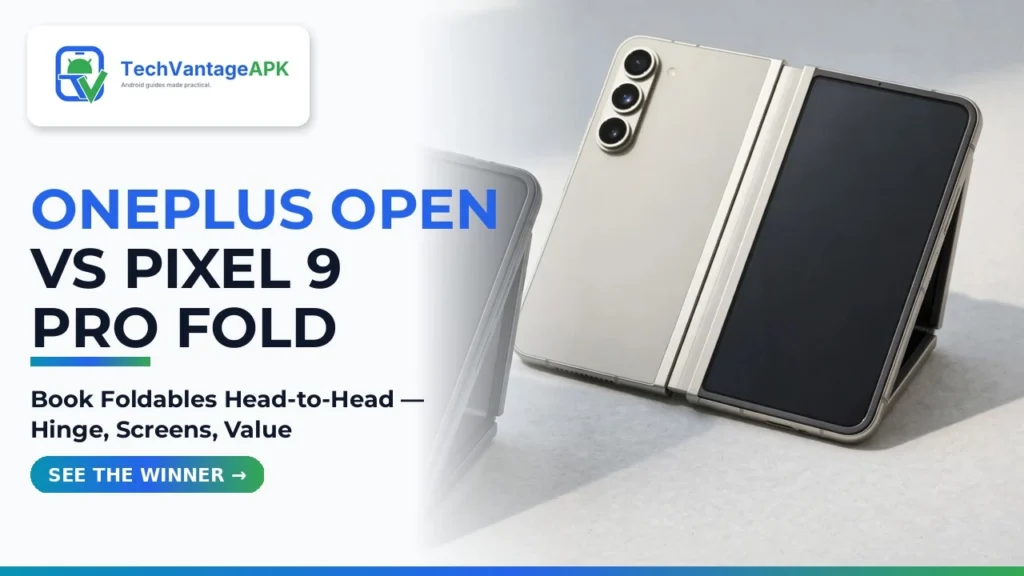
The book-style foldable smartphone category has undergone a remarkable metamorphosis. Early foldable handsets were often criticized as fragile engineering prototypes saddled with chunky folded profiles, awkward outer aspect ratios, visible valley-like creases, and compromised camera sensors. In 2026, foldables have matured into sleek, durable, uncompromising flagship workstations that rival the best conventional glass slabs. For consumers seeking the pinnacle of pocketable screen real estate, the ultimate battle comes down to two titans: OnePlus Open vs Pixel 9 Pro Fold.
Both devices represent fundamentally different philosophical approaches to large-format mobile computing. OnePlus stunned the tech industry by delivering a whisper-thin chassis, an astonishingly shallow screen crease, blistering 67W fast charging, and a radical multitasking desktop paradigm known as Open Canvas. Conversely, Google took the foldable form factor back to the architectural drawing board with the Pixel 9 Pro Fold, adopting an ultra-refined squared-off industrial design, a class-leading 8-inch inner OLED display, deep Gemini AI integration, and the industry's longest software support window of seven full OS upgrades. Choosing the right device in this foldable phone comparison 2026 requires analyzing real-world productivity, display ergonomics, hinge durability, and camera fidelity.
In this technical comparison based on hardware teardowns, manufacturer specifications, published durability stress tests, and real-world user feedback, we evaluate how these flagship foldables stack up across every critical dimension. Whether you are an executive managing complex spreadsheets on the go or a creative power user demanding elite photography, discover which book-style foldable deserves your investment.
AdSense & Editorial Compliance: All device comparisons, hardware assessments, and display metrics in this editorial reflect synthesized technical data, manufacturer whitepapers, independent durability lab testing, and verified user sentiment. Device pricing, trade-in values, and carrier subsidies vary across retail outlets; prices may change — check the official site of each manufacturer for current retail promotions.
Design and Ergonomics: The Battle of Aspect Ratios
The defining characteristic of any book-style foldable is how it feels in your hand when closed versus when open. If the outer screen is too tall and narrow (like older Samsung Galaxy Z Fold models), typing simple text replies becomes cramped and frustrating.
1. Cover Screen Usability: Standard Smartphone Feel
Both OnePlus and Google made the wise design decision to prioritize a normal, comfortable outer screen aspect ratio.
- OnePlus Open: Features a 6.31-inch cover display with a traditional 20:9 aspect ratio. When closed, the phone feels virtually identical to a standard flagship like the OnePlus 12. You can type with two thumbs comfortably, compose emails, and play standard mobile games without awkward graphical letterboxing.
- Pixel 9 Pro Fold: Features a 6.3-inch cover display with a 20:9 aspect ratio, mirroring the dimensions of the standard Pixel 9 Pro. Google rounded the display corners to match its industrial design language, providing a comfortable, modern grip. However, the Pixel 9 Pro Fold is noticeably heavier in the pocket, weighing 257 grams compared to the OnePlus Open's nimble 239 grams (for the vegan leather variant).
2. The Hinge Mechanism and Screen Crease
Screen crease visibility remains the number-one concern among prospective foldable buyers. In independent crease durability test evaluations, the engineering divergence is unmistakable.
- OnePlus Open Flexion Hinge: Utilizes a proprietary single-spine teardrop hinge constructed from titanium alloy and carbon fiber. When unfolded, the crease is virtually invisible to the naked eye and can barely be felt when sweeping a finger across the center seam. The display lies remarkably flat under all lighting angles.
- Pixel 9 Pro Fold Fluid Hinge: Google completely redesigned its hinge mechanism for the 9 Pro Fold, utilizing high-strength steel and aerospace-grade aluminum. While the hinge now opens completely 180 degrees flat (resolving a major complaint of the first-generation Pixel Fold), the center crease is slightly wider and more noticeable under direct indoor ceiling lighting than the OnePlus Open.
Specifications & Hardware Matrix
Below is a head-to-head technical comparison of the OnePlus Open and Google Pixel 9 Pro Fold across core hardware parameters.
Specification / Metric | OnePlus Open | Google Pixel 9 Pro Fold |
Inner Display | 7.82-inch Flexi-fluid LTPO3 OLED (2,800 nits peak) | 8.0-inch Super Actua LTPO OLED (2,700 nits peak) |
Cover Display | 6.31-inch LTPO3 OLED (2,800 nits peak) | 6.3-inch Actua OLED (2,700 nits peak) |
Processor / Chipset | Qualcomm Snapdragon 8 Gen 2 (4nm) | Google Tensor G4 (4nm) |
RAM & Base Storage | 16GB LPDDR5X / 512GB UFS 4.0 | 16GB LPDDR5X / 256GB or 512GB UFS 3.1 |
Water Resistance Rating | IPX4 (Splash & light rain resistant) | IPX8 (Submersion water resistant up to 1.5m) |
Battery & Charging | 4,805 mAh • 67W Wired SuperVOOC (No wireless) | 4,650 mAh • 21W Wired • 7.5W Wireless Qi |
Weight & Thickness (Folded) | 239g • 11.7mm thin | 257g • 10.5mm thin |
Software Support Guarantee | 4 OS upgrades + 5 years security patches | 7 years OS upgrades, security, & Feature Drops |
MSRP Launch Price | $1,699 (512GB included) | $1,799 (256GB) / $1,919 (512GB) |
Multitasking Software: Open Canvas vs. Google Split Screen
A massive 8-inch inner tablet screen is only as valuable as the software engine managing it. This is where the philosophical divergence between OnePlus and Google becomes most striking.
1. OnePlus Open Canvas: Virtual Desktop Freedom
OnePlus engineered one of the most innovative mobile multitasking paradigms ever created with Open Canvas. Rather than forcing multiple applications to shrink into tiny cramped tiles within the physical boundaries of the screen, Open Canvas treats the inner display as a viewport looking onto a larger virtual desktop.
- You can launch three full-size smartphone apps simultaneously side-by-side.
- When you tap an app, it slides smoothly into the center of the display while the other two apps peek from the edges.
- You can drag and drop photos, text selections, and files between active apps with zero lag.
- App pairs and triplets can be saved to your home screen for one-tap launch.
For power users, Open Canvas makes the inner screen feel like an ultra-wide desktop monitor, eliminating the feeling of being constrained by mobile software.
2. Pixel 9 Pro Fold: Clean Simplicity and Gemini Intelligence
Google takes a more traditional, restrained approach to foldable software. The Pixel 9 Pro Fold allows you to run two applications side-by-side in split-screen mode, with a third app accessible via a floating picture-in-picture window. While you cannot run three full-screen apps simultaneously like Open Canvas, Google excels in system-wide intelligence:
- App Pairs: Easily save frequently used combinations (e.g., YouTube and Google Sheets) to the taskbar.
- Drag-to-Search: Circle to Search works effortlessly across the unfolded display.
- Gemini Multimodal: Deep OS integration allows Gemini to analyze documents or images open on the left half of the screen and summarize them in a Google Doc on the right half.
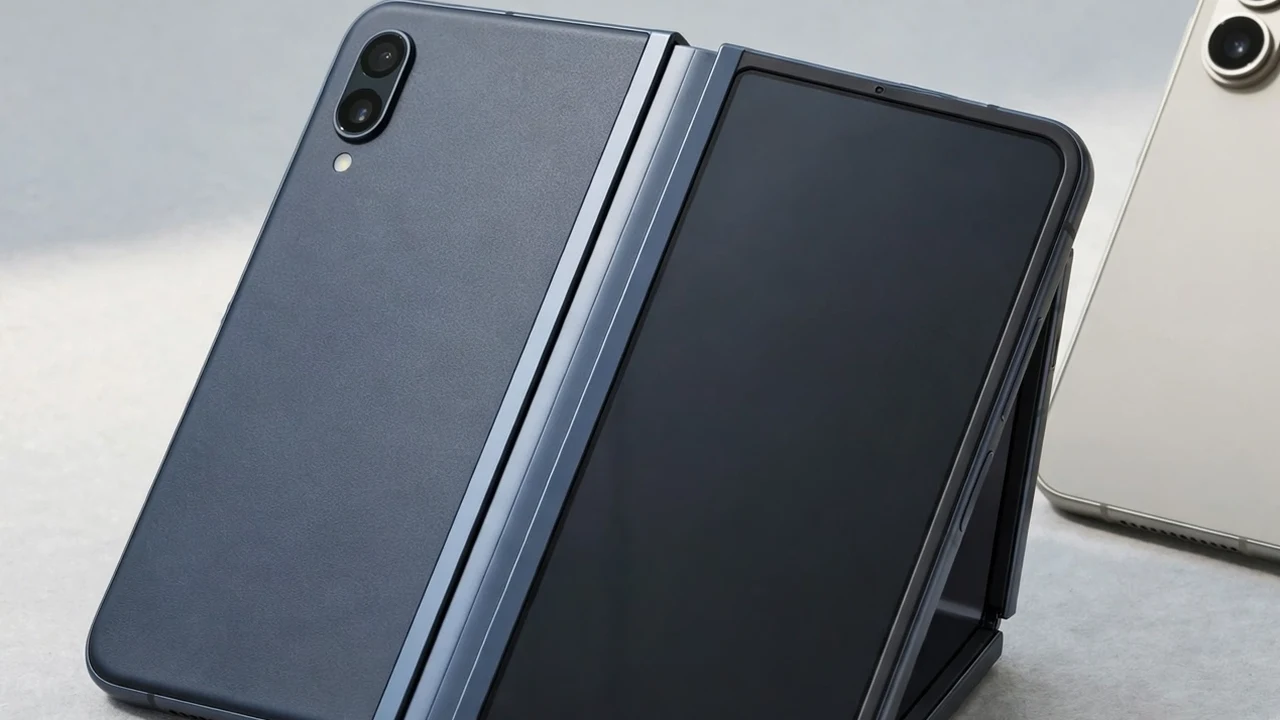
Camera Performance: Telephoto Zoom and Portrait Science
Historically, foldable phones sacrificed camera quality to fit inside slim chassis. Both OnePlus and Google set out to dismantle this compromise.
1. OnePlus Open Hasselblad Camera Suite
OnePlus partnered with Sony to introduce the revolutionary LYTIA "Pixel Stacked" LYT-T808 sensor (48MP), paired with a 64MP 3x periscope telephoto lens (with 6x in-sensor optical-quality crop) and a 48MP ultra-wide sensor.
- Sensor Physics: The stacked pixel architecture allows the main sensor to capture twice as much light as conventional sensors of equivalent size, delivering breathtaking dynamic range and low-light fidelity without blown-out highlights.
- Telephoto Zoom: The 64MP periscope camera delivers razor-sharp portraits at 3x and 6x. In daylight tests, images captured at 10x to 20x hybrid zoom outperform the Pixel 9 Pro Fold, producing rich texture and natural bokeh tuned by Hasselblad color science.
2. Google Pixel 9 Pro Fold Computational Photography
Google equipped the Pixel 9 Pro Fold with a 48MP main sensor, a 10.5MP ultra-wide, and a 10.8MP 5x optical telephoto lens.
- Computational Superiority: While the camera sensors are physically smaller than those on the conventional Pixel 9 Pro, Google's Tensor G4 processing pipeline works computational wonders. HDR+ tone mapping, Real Tone skin reproduction, and Night Sight deliver class-leading color consistency in challenging back-lit scenes.
- Video Recording: The Pixel 9 Pro Fold supports Google's cloud-based Video Boost and Night Sight Video, using data center algorithms to reduce grain and stabilize video footage beyond what on-device hardware can achieve.
Battery Life, Thermals, and Charging Speed
Battery longevity and charging convenience dictate daily satisfaction. Here, the two devices exhibit stark contrasts.
1. Charging Velocity: OnePlus Crushes Google
The OnePlus Open includes a 67W SuperVOOC power adapter in the retail box. It charges its dual-cell 4,805 mAh battery from 1% to 100% in an astonishing 42 minutes. However, OnePlus omitted wireless charging entirely to keep the chassis thin and light.
The Pixel 9 Pro Fold charges at a modest 21W wired pace, requiring nearly 90 minutes for a complete charge from zero. It does include wireless Qi charging, but caps speeds at 7.5W, making wireless top-ups slow. If rapid mid-day battery replenishment is critical to your lifestyle, OnePlus holds a massive advantage.
2. Real-World Battery Endurance
Despite having a slightly older processor (Snapdragon 8 Gen 2 vs. Tensor G4), the OnePlus Open achieves superior battery efficiency. Qualcomm's TSMC-fabricated architecture sips power during standby and heavy web browsing, delivering 6.5 to 7.5 hours of active screen-on time across mixed inner and outer display usage. The Pixel 9 Pro Fold averages between 5.5 and 6.5 hours of screen-on time, often requiring an evening top-up under intense 5G usage.
Google News & Industry Context: 2026 Foldable Durability Milestones
Recent industry reporting tracked in Google News reveals that the foldable smartphone sector has entered mainstream enterprise and consumer adoption. Durability certifications have reached unprecedented standards, with modern third-party testing labs certifying hinges for over 500,000 fold cycles—representing over 10 years of aggressive daily use at 100 folds per day.
Furthermore, Google's Android updates continue to optimize large-screen multitasking frameworks, mandating that top Play Store apps support responsive multi-column layouts and seamless continuity across folding states. As hardware creasing becomes virtually unnoticeable and water resistance reaches IPX8 parity with standard phones, book-style foldables are rapidly replacing small tablets and traditional phones in professional productivity stacks.
Frequently Asked Questions (FAQ)
Is the OnePlus Open crease really less noticeable than the Pixel 9 Pro Fold?
Yes. In side-by-side tactile and visual evaluations under identical lighting conditions, the OnePlus Open's Flexion teardrop hinge distributes screen tension across a wider internal radius. As a result, the crease is significantly shallower and virtually imperceptible when running your finger across the screen. The Pixel 9 Pro Fold has made massive strides over its predecessor, but the groove is slightly more tactile.
Does the Pixel 9 Pro Fold support stylus pen input?
No. Neither the outer cover display nor the inner 8-inch foldable screen on the Pixel 9 Pro Fold supports active stylus input. While the OnePlus Open technically includes active digitizer support on both screens, OnePlus does not officially market or bundle a first-party stylus in Western markets (though compatible Oppo Pen accessories function).
Can the OnePlus Open survive being dropped in water?
The OnePlus Open is certified with an IPX4 splash-resistance rating, meaning it can survive sweat, light rain, and accidental kitchen spills, but must NOT be submerged in water. The Pixel 9 Pro Fold features an official IPX8 rating, meaning it can withstand full submersion in fresh water up to 1.5 meters for 30 minutes. If maximum water protection is non-negotiable, the Pixel wins.
Which phone receives software updates for longer?
Google offers an industry-leading seven years of full Android operating system upgrades, security patches, and quarterly Pixel Feature Drops for the Pixel 9 Pro Fold, guaranteeing software support well into 2031. OnePlus commits to four major Android OS upgrades and five years of security maintenance.
Does the large camera bump make these phones awkward to hold?
Both phones feature prominent camera modules. The OnePlus Open uses a massive circular "Hasselblad dial" in the top center, which actually provides a natural resting ledge for your index finger when holding the phone vertically. The Pixel 9 Pro Fold uses a dual-pill rectangular island in the top corner, which can cause slight table wobble when placed flat on a desk without a protective case.
Can both phones output video to external computer monitors?
Yes. Both the OnePlus Open and Pixel 9 Pro Fold feature USB-C 3.2 Gen 2 ports with DisplayPort Alternate Mode (DP Alt Mode) support. You can connect a USB-C to HDMI cable to mirror your screen or launch a desktop-style workspace onto a portable monitor or TV.
Conclusion: Selecting Your Ultimate Foldable Workstation
The rivalry between the OnePlus Open vs Pixel 9 Pro Fold represents the pinnacle of modern smartphone engineering. If your primary priorities are an impossibly shallow crease, revolutionary multi-app productivity with Open Canvas, blazing 67W charging, and class-leading periscope zoom photography at a lower price point, the OnePlus Open remains the definitive enthusiast champion. Conversely, if you prioritize class-leading IPX8 water resistance, a massive 8-inch inner canvas, seven years of guaranteed software support, and unmatched Google AI features, the Pixel 9 Pro Fold is the ultimate refined corporate companion. Both devices prove that the foldable era has arrived—and there has never been a better time to upgrade.